



What's Happening?
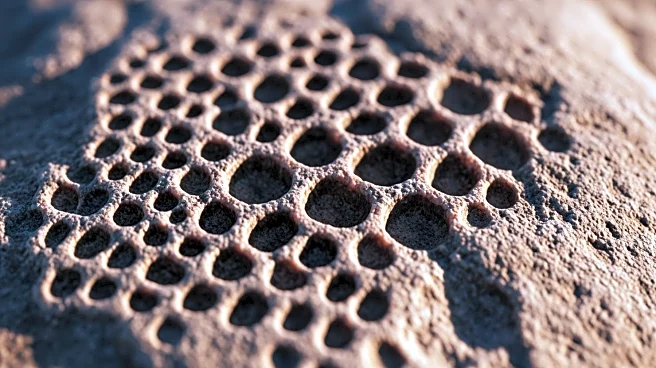
Researchers have discovered ancient bee nests within fossilized bones in a limestone cave on the Caribbean island of Hispaniola. This finding, published in the journal Royal Society Open Science, marks the first recorded instance of bees using bones to nest and lay
eggs. The nests, dating back approximately 20,000 years, were found in the empty tooth sockets of fossilized bones from now-extinct animals. This discovery provides new insights into the nesting behaviors of bees, which are typically solitary and nest in the ground or within plant stems. The study was led by Lázaro Viñola-López, a postdoctoral researcher at the Field Museum of Natural History in Chicago.
Why It's Important?
The discovery of these ancient bee nests expands the understanding of bee ecology and their adaptability to different environments. It challenges the conventional knowledge of bee nesting behaviors and highlights the diversity of nesting processes among bee species. This finding could have implications for the study of bee evolution and their responses to environmental changes over time. Additionally, it underscores the importance of preserving fossil sites, as they can provide valuable insights into the behaviors and adaptations of ancient species. The research also emphasizes the need for careful examination of fossils to uncover hidden ecological information.
What's Next?
Researchers plan to conduct further surveys in the area to determine if similar nesting behaviors are present in other caves or on other islands. They aim to identify whether the bees responsible for these nests are extinct or still exist today. This ongoing research could lead to a deeper understanding of bee biodiversity and their ecological roles in ancient environments. The study also encourages paleontologists to look for similar nesting evidence in other fossil sites, potentially revealing more about the evolutionary history of bees.