



What's Happening?
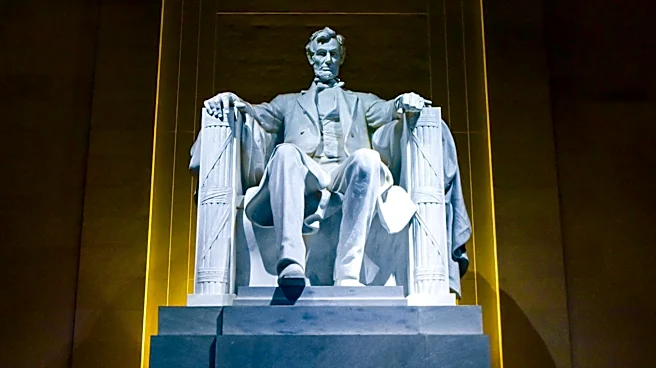
On November 19, 1863, President Abraham Lincoln delivered the Gettysburg Address, a speech that fundamentally reshaped the understanding of American identity and the Declaration of Independence. Delivered at the dedication of a cemetery for Union soldiers
killed in the Battle of Gettysburg, the address transformed the site of a major American division into a symbol of national unity. According to historian Garry Wills, Lincoln's speech positioned equality as the foremost principle of the Declaration, effectively correcting the spirit of the Constitution without overthrowing it. This intellectual revolution, as Wills describes it, rendered previous arguments for states' rights largely ineffective in both legal and popular discourse. The address fostered a new vision of the United States as a single people dedicated to a proposition, leading to a profound change in the nation's self-perception.
Why It's Important?
The Gettysburg Address holds immense importance in American history and political thought. By reinterpreting the Declaration of Independence, President Lincoln provided a moral and philosophical foundation for the Union cause during the Civil War, emphasizing human equality and a unified national purpose over sectional interests and states' rights. This redefinition has had a lasting impact on American jurisprudence and public opinion, solidifying the idea of a singular national identity. The speech's emphasis on 'a new birth of freedom' continues to inspire movements for civil rights and equality, underscoring the ongoing struggle to realize the nation's founding ideals. Its influence extends to how Americans perceive their foundational documents, making it a cornerstone of national identity and a reference point for discussions on liberty and justice.
Beyond the Headlines
The enduring legacy of the Gettysburg Address lies in its ability to transcend its immediate historical context and offer a timeless articulation of American ideals. Its impact goes beyond political rhetoric, influencing cultural narratives and educational curricula. The speech's concise yet powerful language has made it one of the most quoted and studied texts in American history, shaping the collective memory of the Civil War and its aftermath. The address also highlights the dynamic nature of constitutional interpretation and the power of presidential rhetoric to redefine national purpose. Its continued relevance in contemporary debates about national unity, civil rights, and the meaning of American democracy demonstrates its profound and lasting influence on the nation's ethical and legal framework.