






What's Happening?
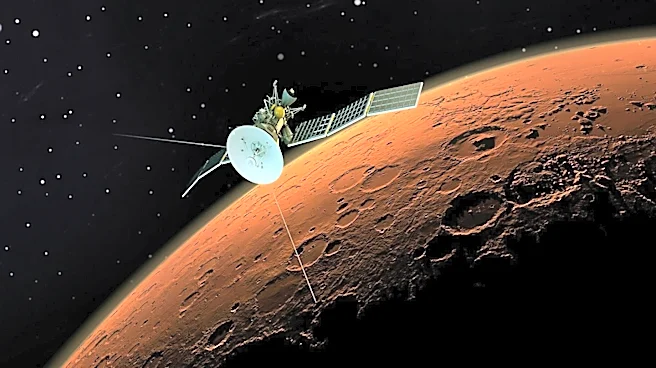
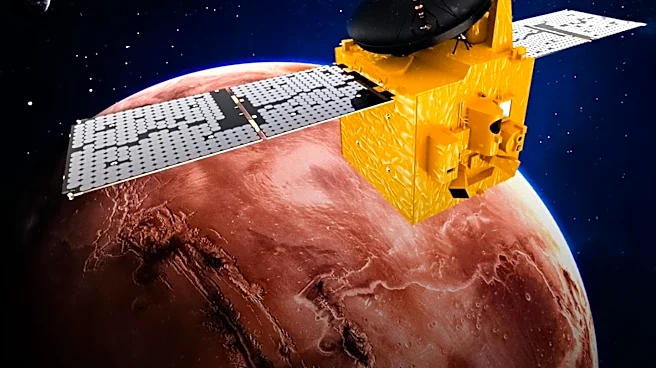
NASA's Psyche mission has successfully captured a series of images showing the crescent of Mars as the spacecraft approached the planet for a gravity assist maneuver. This event took place from May 2 to May 15, 2026. The images, taken by the spacecraft's
multispectral imager instrument, depict Mars initially as a small crescent, which grows larger as the spacecraft nears the planet. The close approach allowed Psyche to capture high-resolution images of Mars' surface. The mission team compiled these images into a time-lapse video, showcasing the entire encounter with Mars. This gravity assist is a crucial part of the Psyche mission, which aims to study the metal-rich asteroid Psyche, located in the asteroid belt between Mars and Jupiter.
Why It's Important?
The Psyche mission's successful gravity assist and the resulting images are significant for several reasons. Firstly, the maneuver is a critical step in the mission's trajectory, allowing the spacecraft to gain the necessary speed to reach its primary target, the asteroid Psyche. The high-resolution images of Mars provide valuable data for scientists studying the planet's surface and atmosphere. Additionally, the mission demonstrates the capabilities of NASA's spacecraft in conducting complex maneuvers and capturing detailed planetary images. This success enhances NASA's reputation in planetary exploration and contributes to the broader understanding of our solar system.
What's Next?
Following the successful gravity assist, the Psyche spacecraft will continue its journey towards the asteroid Psyche. The mission is expected to arrive at the asteroid in 2029, where it will conduct a detailed study of its composition and structure. The data collected will help scientists understand the building blocks of planet formation and the history of our solar system. The mission's progress will be closely monitored by NASA, and further updates are anticipated as the spacecraft approaches its target.