


What's Happening?
Researchers have unearthed the first known trackway of an adult Tyrannosaurus rex in North Dakota. This discovery, detailed in the Journal of Vertebrate Paleontology, consists of a 7-meter (23-foot) long path preserving four footprints, each approximately
1 meter (3.2 feet) long and up to 0.80 meters (2.6 feet) wide. The trackway dates back 66.5 million years ago, just before the asteroid impact that led to the extinction of non-avian dinosaurs. While T. rex skeletal remains are relatively common, trackways are exceptionally rare, with only a couple of isolated footprints previously found in New Mexico and Montana. This new finding provides a unique glimpse into the behavior and movement of an adult T. rex, offering insights that skeletal remains cannot. The track separation suggests an average stride length of about 4 meters (13.1 feet), indicating an estimated walking speed of 1.5 to 2 meters per second (3.3 to 4.5 miles per hour). Three of the footprints are slated to be airlifted to the Denver Museum of Nature & Science.
Why It's Important?
This discovery is significant because it offers direct evidence of an adult T. rex's movement and behavior, which is rarely preserved in the fossil record. Unlike bones, footprints capture a specific moment in an animal's life, providing data on stride length and estimated walking speed. This information helps paleontologists refine their understanding of how these massive predators navigated their environment. The rarity of such trackways makes this find particularly valuable for reconstructing the ecological dynamics of the late Cretaceous period. It also highlights the challenges in preserving and identifying trackways, as they require specific conditions and can be difficult to distinguish from other large theropod or ornithopod tracks. The find contributes to a broader understanding of tyrannosaurid behavior, supplementing previous findings that hinted at gregariousness in smaller tyrannosaurids. The preservation of these footprints allows for a more complete picture of the T. rex beyond its skeletal anatomy.
What's Next?
The three best-preserved footprints from the trackway are scheduled to be airlifted to the Denver Museum of Nature & Science, where they will be preserved and made accessible for further study and public display. While additional excavations at the site are deemed unlikely due to the steep 'gumbo' butte overburden, researchers will continue to analyze the existing trackway data. This analysis may lead to further insights into T. rex locomotion, weight distribution, and potential interactions with its environment. The discovery also encourages continued exploration for similar trackways in other regions, as such finds are crucial for understanding the behavioral aspects of extinct megafauna. The scientific community will likely integrate this new data with existing fossil records to develop more comprehensive models of T. rex biology and ecology.
Beyond the Headlines
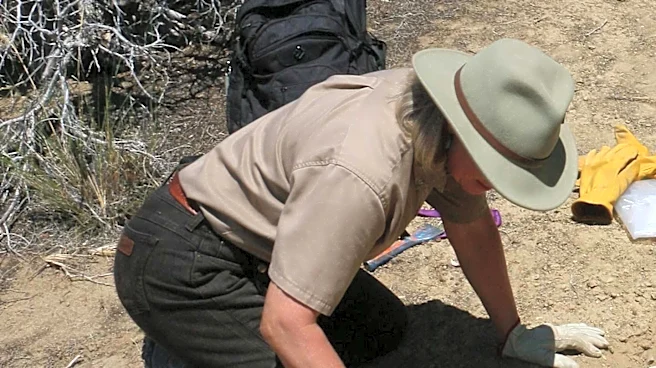
The discovery of the T. rex trackway transcends mere scientific data, offering a profound connection to the past and inspiring public interest in paleontology. The fact that an amateur fossil sleuth, Kent Hups, a science teacher, made the initial discovery underscores the importance of citizen science and the role of curiosity and careful observation in scientific advancement. This find not only enriches our scientific understanding but also fuels the public's imagination about the creatures that once roamed Earth. It highlights the ongoing potential for significant discoveries in well-explored areas and the value of preserving such unique geological and paleontological sites. The trackway serves as a tangible link to a prehistoric world, reminding us of the vastness of geological time and the continuous evolution of life on our planet.