




What's Happening?
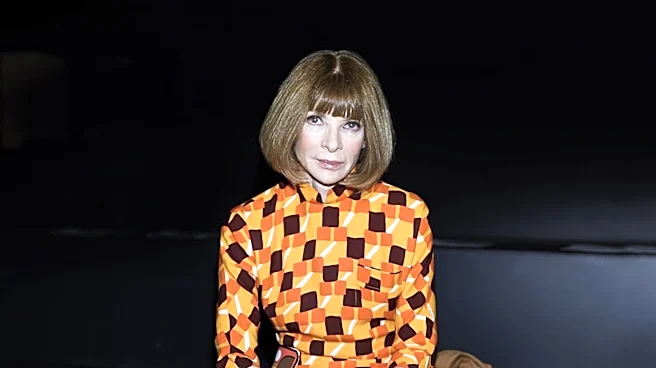
Tom Kennedy, a prominent American television game show host, and Anna Wintour, an influential British-American media executive in fashion journalism, are frequently searched together online, leading to speculation about their relationship. However, available
biographical information confirms no personal or professional connection between them. Kennedy, born James Edward Narz in 1927, was known for hosting shows like 'You Don’t Say!' and 'Name That Tune,' retiring in 1989 and passing away in 2020. Wintour, born in 1949, has been editor-in-chief of American Vogue since 1988 and currently serves as Vogue’s global editorial director and Condé Nast’s chief content officer. Their careers developed in entirely separate industries: Kennedy in television entertainment and Wintour in fashion publishing and media management. Despite their names appearing together in search results, there is no evidence of them being relatives, romantic partners, or business associates.
Why It's Important?
The persistent online association of Tom Kennedy and Anna Wintour, despite a lack of any actual connection, highlights a broader issue in the digital age: how search algorithms and user curiosity can create perceived links where none exist. This phenomenon can lead to misinformation and misinterpretations of public figures' lives and careers. For the public, it underscores the importance of verifying information from credible sources rather than relying solely on search engine suggestions. For media professionals and public figures, it illustrates the challenges of managing public perception in an environment where unrelated names can become linked through algorithmic patterns, potentially diluting individual legacies or creating unnecessary speculation. This situation also reflects how different generations of media personalities, operating in distinct spheres, can become inadvertently intertwined in the digital consciousness.
What's Next?
Given the nature of online search behavior and algorithmic suggestions, it is likely that searches linking Tom Kennedy and Anna Wintour will continue. As more biographical content about both figures becomes digitized and indexed, the potential for these unrelated searches to persist remains high. Media outlets and biographical platforms may continue to address this common query by explicitly stating the lack of connection, as this article does, to clarify for the public. There are no foreseeable direct actions from either individual's estate or from Anna Wintour herself regarding this online phenomenon, as it primarily stems from user search patterns rather than any direct misrepresentation by a single entity. The ongoing challenge will be for information consumers to critically evaluate search results and seek out verified biographical details.
Beyond the Headlines
This case offers a subtle insight into the evolving landscape of celebrity and public perception in the internet era. It demonstrates how individual identities, once largely defined by their respective industries and media appearances, can become fluid and interconnected through the mechanics of search engines. The 'why' behind such searches often involves name confusion (as multiple individuals share the name Tom Kennedy), the high public profile of one individual (Anna Wintour), and the way search engines cluster related or frequently co-occurring terms. This phenomenon subtly erodes the distinct boundaries of individual careers, creating a digital tapestry where disparate figures can appear linked. It also raises questions about digital legacy and how public figures' narratives are constructed and consumed in an age dominated by algorithms, often without direct human intent or factual basis.