



What's Happening?
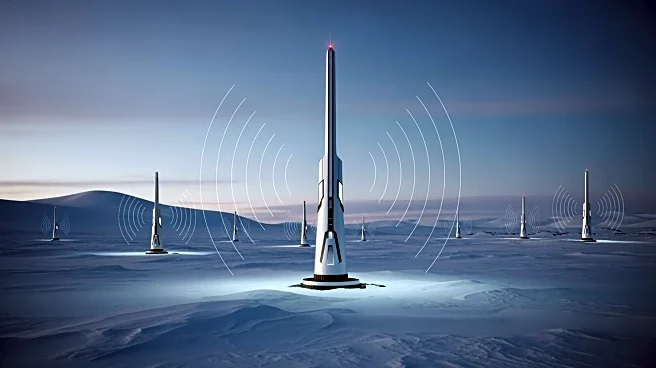
The Antarctic Impulsive Transient Antenna (ANITA) experiment, designed to detect radio waves from cosmic rays, has recorded a series of unexplained signals originating from beneath Antarctica's ice. These signals, observed between 2016 and 2018, defy
current particle physics models, as they appear to come from steep angles beneath the ice, rather than from above. The energy levels of these radio pulses do not align with the behavior of typical neutrinos, which are a primary focus in particle physics. Despite extensive investigation, no conventional explanation has been accepted, leading scientists to speculate about the possibility of new particles or interactions, potentially linked to dark matter.
Why It's Important?
The discovery of these anomalous signals is significant as it challenges existing theories in particle physics and could potentially lead to groundbreaking discoveries. If linked to dark matter, which constitutes a large portion of the universe's mass but remains largely undetected, it could revolutionize our understanding of the universe. The implications extend to fundamental physics, potentially altering how scientists perceive particle interactions and cosmic phenomena. The lack of similar findings from other experiments, however, makes the dark matter hypothesis speculative, highlighting the need for further research and validation.
What's Next?
To further investigate these signals, scientists are developing the Payload for Ultrahigh Energy Observations (PUEO) experiment, an advanced version of ANITA. This new detector aims to enhance sensitivity and detection capabilities, using techniques like interferometry to better measure radio waves and reduce background noise. Researchers hope that PUEO will provide clearer insights into the source of these signals, potentially confirming or refuting the dark matter hypothesis. The ongoing research in Antarctica continues to push the boundaries of physics, with the potential to uncover new phenomena or particles.