
What's Happening?
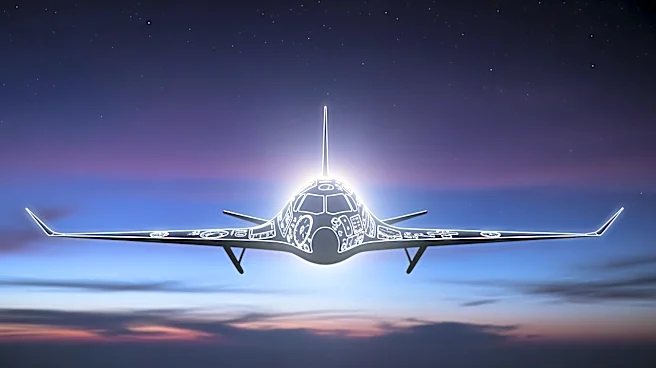
NASA's Boeing 777 aircraft has returned to Langley Research Center in Virginia after undergoing significant modifications to serve as a next-generation airborne science laboratory. The aircraft, which
was acquired in 2022 to replace the retired DC-8, has been equipped with advanced research stations and extensive wiring to support scientific instruments such as lidar and infrared imaging spectrometers. These upgrades allow the aircraft to collect data during flights lasting up to 18 hours, accommodating 50 to 100 operators and carrying 75,000 pounds of equipment. The inaugural science mission, scheduled for January 2027, will focus on high-impact winter weather events across North America, Europe, Greenland, and the Arctic and North Atlantic Oceans.
Why It's Important?
The transformation of NASA's Boeing 777 into an airborne science laboratory marks a significant advancement in the agency's capacity to conduct Earth science research. By expanding its airborne research capabilities, NASA can gather more comprehensive data to improve understanding of the Earth's systems and enhance life on the planet. The aircraft's ability to host a larger number of operators and instruments will facilitate collaboration with more partners and educational opportunities, potentially leading to breakthroughs in atmospheric science and environmental monitoring. This development underscores NASA's commitment to advancing scientific knowledge and supporting satellite data usage.
What's Next?
The Boeing 777's first mission, the North American Upstream Feature-Resolving and Tropopause Uncertainty Reconnaissance Experiment (NURTURE), is set to deploy in January 2027. This mission will investigate severe winter weather phenomena, providing detailed atmospheric observations that could improve weather forecasting and climate models. As NASA continues to enhance its airborne science program, further collaborations and technological advancements are expected, potentially leading to new scientific discoveries and improved environmental policies.