



What's Happening?
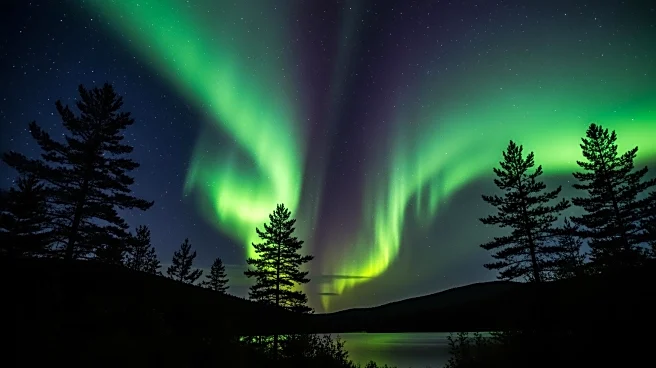
A solar blast is expected to bring the northern lights into view for parts of Oregon, including the Portland area, late Wednesday night. The National Oceanic and Atmospheric Administration's Space Weather Prediction Center has issued a geomagnetic-storm
watch, indicating that the aurora could be visible in approximately 21 states, including Oregon. The visibility of the aurora in Oregon will depend on the timing and strength of a coronal mass ejection anticipated to arrive later in the week. The best chance to see the aurora will be from a dark, open area away from city lights, as the display is expected to be faint and low on the northern horizon. The NOAA provides a 30-minute aurora forecast that updates in real-time, offering the latest predictions on aurora visibility.
Why It's Important?
The potential visibility of the northern lights in Oregon is a rare opportunity for residents to witness this natural phenomenon, typically seen in higher latitudes. This event highlights the impact of solar activity on Earth's atmosphere and the resulting geomagnetic storms that can extend auroral displays to lower latitudes. For local communities, this event could boost interest in astronomy and natural sciences, encouraging educational and recreational activities centered around skywatching. Additionally, the event underscores the importance of monitoring space weather, as geomagnetic storms can affect satellite operations, power grids, and communication systems.
What's Next?
The visibility of the northern lights will largely depend on local weather conditions, with forecasts predicting mostly cloudy skies over much of Oregon. If the cloud cover breaks, residents are advised to seek elevated vantage points on the northern coast or in the eastern highlands for the best viewing experience. Continued monitoring of the NOAA's aurora forecast will provide updates on the likelihood of seeing the aurora. This event may also prompt discussions on the broader implications of solar activity and its effects on technology and infrastructure.