
What's Happening?
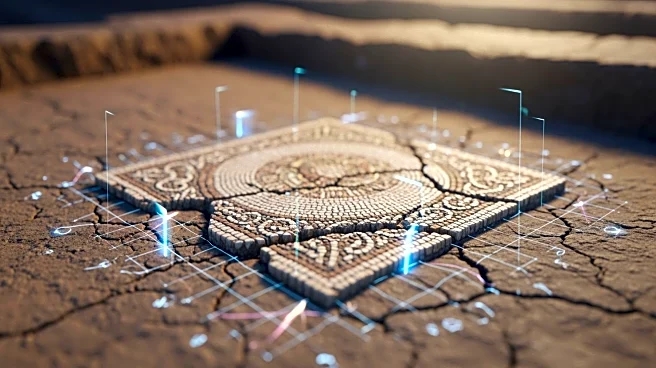
Researchers are employing digital archaeology to uncover previously hidden aspects of ancient Pompeii, a city buried by the eruption of Mount Vesuvius in AD 79. The Pompeii Reset project, led by Dr. Susanne
Muth from Humboldt University, uses advanced techniques like LiDAR scans and 3D modeling to reconstruct the city's lost architecture. This approach has revealed new insights into the city's skyline, including the existence of towers that were symbols of wealth and power. The project aims to provide a more nuanced understanding of daily life in Pompeii by digitally reconstructing its buildings and structures.
Why It's Important?
The use of digital archaeology in Pompeii is significant as it offers a non-invasive method to preserve and study ancient sites, which are often fragile and susceptible to environmental changes. This approach not only helps in preserving cultural heritage but also enhances our understanding of historical urban landscapes. By reconstructing lost architecture, researchers can gain insights into the social and economic structures of ancient societies. The findings could influence how archaeologists approach the study of other ancient sites, potentially leading to new discoveries about historical civilizations.
What's Next?
The Pompeii Reset project plans to continue its work by digitally reconstructing more buildings in Pompeii. The team aims to create comprehensive models of the city, which could be used for educational purposes and to inform future archaeological research. As the project progresses, it may uncover more about the daily lives of Pompeii's residents and the city's architectural innovations. The ongoing research could also inspire similar projects at other archaeological sites, promoting the use of digital tools in heritage preservation.