

What's Happening?
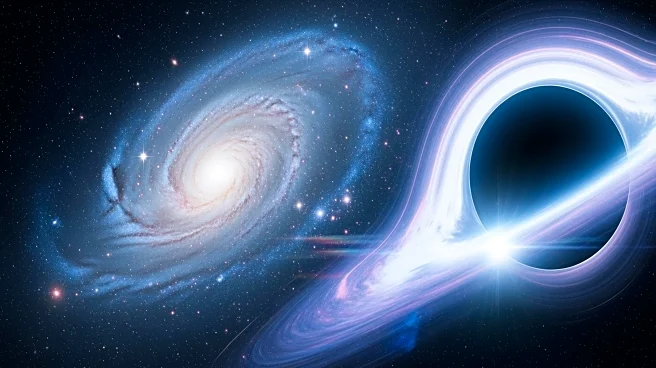
In 2014, a NASA telescope observed a massive star in the Andromeda galaxy emitting an increasingly intense infrared light over three years before it dramatically faded and disappeared, leaving a dust shell. This phenomenon, unnoticed for years, was recently
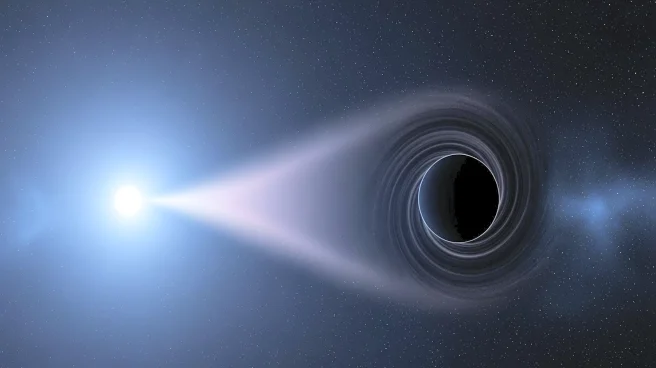
explained by a research team led by Columbia astronomy professor Kishalay De. They concluded that the star underwent a direct collapse, forming a black hole without a supernova explosion, a process long theorized but rarely observed. The star, named M31-2014-DS1, was a hydrogen-depleted supergiant, initially 13 times the mass of the sun, and reduced to five times the sun's mass at its death. This discovery, published in the journal Science, provides significant insights into stellar evolution and black hole formation.
Why It's Important?
This discovery challenges the traditional understanding of how massive stars end their life cycles. Typically, such stars are expected to explode as supernovae before collapsing into black holes. The direct collapse observed in M31-2014-DS1 suggests that stars of similar mass might not always explode, indicating a more complex interaction of gravity, gas pressure, and shock waves within dying stars. This finding could reshape theories on stellar deaths and black hole formation, impacting astrophysical models and our understanding of the universe's evolution. It highlights the potential for many such events to occur unnoticed, suggesting a need for more comprehensive observational strategies.
What's Next?
The research team plans to continue analyzing archival data to identify more instances of direct collapse, aiming to refine models of stellar evolution and black hole formation. This could lead to a better understanding of the frequency and conditions under which stars undergo direct collapse. The findings may prompt further studies into the mechanisms preventing supernova explosions in certain stars, potentially influencing future astronomical research and observation techniques.
Beyond the Headlines
The discovery underscores the importance of revisiting archival astronomical data, as significant phenomena may go unnoticed without thorough analysis. It also raises questions about the completeness of current stellar death inventories and the potential for other unobserved processes in the universe. This event could inspire advancements in infrared observational technology and methodologies, enhancing the ability to detect and study similar occurrences.