



What's Happening?
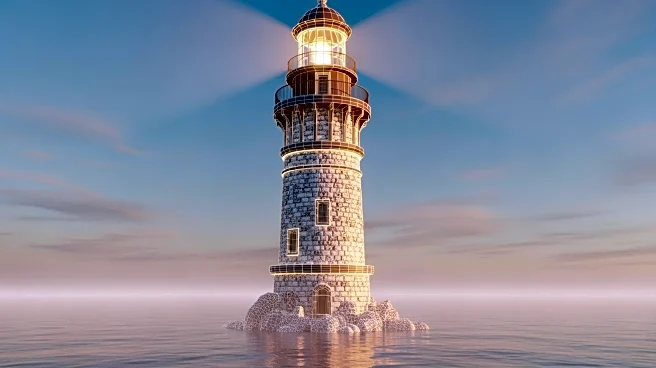
A collaborative effort known as the Pharos Project is underway to digitally reconstruct the ancient Lighthouse of Alexandria, one of the Seven Wonders of the Ancient World. Led by French and Egyptian archaeologists, the project involves documenting approximately
5,000 submerged fragments of the lighthouse, which are scattered across 18 acres of seafloor near modern Alexandria. Using photogrammetry, the team is creating a 3D model of the structure, which once stood 460 feet tall and was a significant landmark until it was destroyed by earthquakes in the 14th century. The reconstruction process has revealed sophisticated construction techniques, such as interlocking limestone and granite blocks, and has provided new insights into the lighthouse's design and scale. Additionally, the project has noted a 26-foot rise in local sea levels since the third century BC.
Why It's Important?
The digital reconstruction of the Lighthouse of Alexandria is significant for both historical scholarship and cultural heritage preservation. By providing a detailed 3D model, the project offers new insights into ancient engineering and architectural practices, challenging previous assumptions about the capabilities of ancient builders. This endeavor not only enhances our understanding of historical structures but also serves as a tool for education and tourism, potentially attracting interest and investment in the region. Furthermore, the project underscores the importance of preserving cultural heritage through modern technology, offering a model for similar efforts worldwide.
What's Next?
The Pharos Project is expected to continue for several more years, as the team works to complete the digital reconstruction. This ongoing effort may lead to further discoveries about the lighthouse and its historical context. As the project progresses, it could inspire similar initiatives to digitally preserve other ancient structures. Additionally, the findings may prompt discussions among historians and archaeologists about the implications of sea level changes on ancient coastal sites, potentially influencing future research and conservation strategies.