




What's Happening?
Experts from various countries convened at the 7th Symposium on Global Maritime Cooperation and Ocean Governance in Sanya, China, to call for stronger international collaboration in maritime security, fisheries, and marine conservation. Discussions highlighted
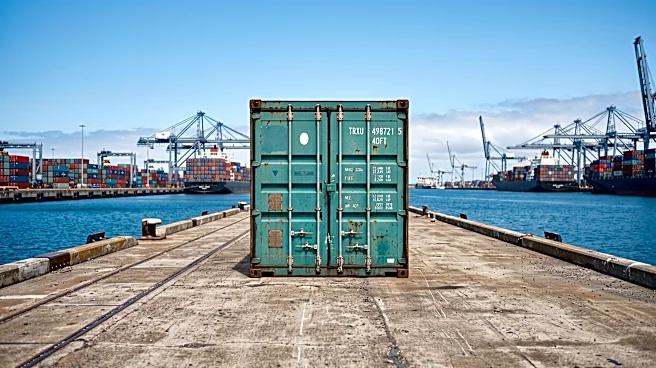
the ocean's critical role in global trade, food production, and coastal livelihoods. The global ocean economy generated $3.5 trillion in gross value added in 2025 and supported 103 million full-time-equivalent jobs, according to an OECD report. Global trade in ocean-related goods and services reached approximately $2.5 trillion in 2025, with services accounting for 58% of the total, as per UNCTAD data from June 2026. Jayanath Colombage, former chief of the Navy of Sri Lanka and former ambassador to Indonesia, emphasized the evolving nature of maritime security, now encompassing cyberspace, undersea cables, satellites, and outer space. The importance of international cooperation was a recurring theme, with experts stressing that efforts to protect the ocean would fail without multilateral commitment.
Why It's Important?
The call for enhanced international cooperation underscores the interconnectedness of global economies and environments. The ocean economy's substantial contribution to global GDP and employment highlights its vital role in sustaining livelihoods and facilitating trade. Disruptions to maritime security, such as damage to submarine telecommunications cables that carry over 99% of international data traffic, can have far-reaching consequences for communications, financial services, and essential operations worldwide. The emphasis on sustainable fisheries and marine conservation is crucial for global food security and the preservation of marine biodiversity, which directly impacts coastal communities. Without concerted international efforts, the challenges of overfishing, pollution, and climate change effects on oceans could escalate, leading to significant economic and ecological instability.
What's Next?
The discussions at the symposium suggest a continued push for integrating ocean action into national policies and international agreements. Future efforts will likely focus on translating calls for cooperation into practical measures, including establishing common international rules and standards for maritime security, supporting sustainable fisheries, and preserving marine environments. There is an anticipated need for increased financial investment in ocean protection and the development of mechanisms to ensure such funding is predictable and accessible. Stakeholders, including governments, international organizations, and industry leaders, are expected to explore avenues for technology sharing and capacity building, particularly in areas like sustainable aquaculture and marine conservation, to address the growing pressures on marine resources.
Beyond the Headlines
The symposium's emphasis on international cooperation reflects a growing recognition that ocean governance is a shared responsibility transcending national borders. The evolving definition of maritime security, to include cyber and space dimensions, points to a broader understanding of threats and vulnerabilities in the modern era. This shift necessitates a re-evaluation of traditional security paradigms and encourages integrated approaches that consider technological advancements. Furthermore, the discussions highlight the ethical imperative to balance economic development with environmental stewardship, acknowledging humanity's role within planetary biodiversity. The long-term implications involve fostering a global culture of multilateralism and shared accountability to ensure the health and sustainability of ocean ecosystems for future generations, addressing not just economic but also social and ecological justice.