


What's Happening?
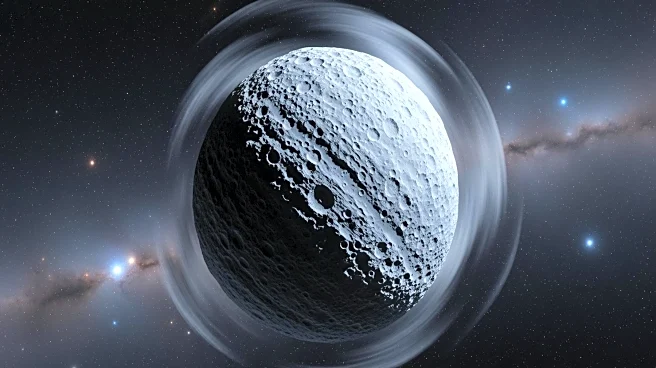
The Vera Rubin Observatory has discovered the fastest-spinning large asteroid, 2025 MN45, which completes a rotation every 1.88 minutes. This asteroid, located in the main asteroid belt between Mars and Jupiter, measures approximately 0.4 miles in diameter.
The discovery was made as part of the observatory's initial dataset, which included nearly 2,000 newly identified asteroids. The rapid rotation of 2025 MN45 suggests it is composed of material with high cohesive strength, challenging the common belief that most asteroids are 'rubble piles' of loosely bound debris.
Why It's Important?
The discovery of 2025 MN45 provides critical insights into the composition and structural integrity of asteroids. Understanding the rotation rates and physical properties of such celestial bodies can inform models of asteroid formation and evolution. This knowledge is essential for assessing potential asteroid impact risks and developing strategies for planetary defense. The Vera Rubin Observatory's findings highlight the observatory's capability as a powerful tool for astronomical discovery, offering a glimpse into the future of space exploration and research.
What's Next?
As the Vera Rubin Observatory continues to ramp up operations, it will embark on its primary science mission, the Legacy Survey of Space and Time (LSST). This decade-long project aims to create a comprehensive, time-lapse record of the universe, capturing images every 40 seconds. The survey will enhance our understanding of the dynamic universe, including the behavior of asteroids and other celestial phenomena. The observatory's ongoing discoveries will contribute to the broader field of astronomy and potentially uncover new aspects of the cosmos.