







What's Happening?
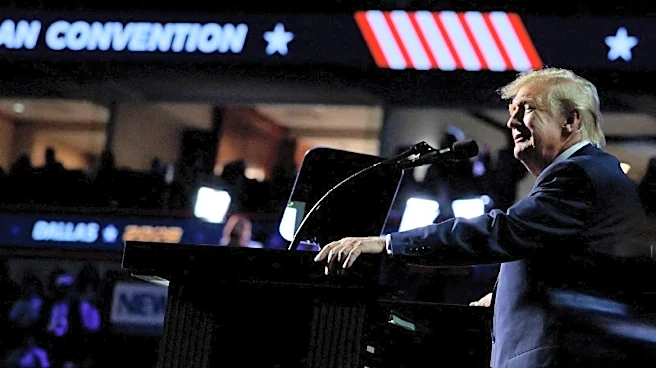
President Trump has urged the Senate to advance the Clarity Act following discussions with cryptocurrency executives at the White House. The Clarity Act, which previously passed the House of Representatives, aims to establish a comprehensive regulatory
framework for classifying digital assets as securities, commodities, or payment stablecoins. The bill is currently facing a September vote after missing its August deadline, with ongoing disputes between banking interests and crypto businesses. President Trump emphasized the importance of this legislation for the U.S. to maintain its competitive edge against China in cryptocurrency and emerging technologies like artificial intelligence and prediction markets. He specifically called for the passage of a 'fair version of the Clarity Act.' Additionally, when asked about potential government Bitcoin purchases, President Trump expressed openness to recommendations from regulators. His 2025 executive order established a strategic Bitcoin reserve that prevents the sale of existing government holdings, primarily assets seized through law enforcement, but does not authorize new acquisitions.
Why It's Important?
The passage of the Clarity Act is crucial for providing regulatory certainty to the cryptocurrency industry in the U.S. The current lack of clear classification standards for digital assets has created an uncertain operating environment for businesses, impacting compliance, legal, and product development. A defined framework would allow companies to confidently invest and innovate, potentially accelerating hiring and fostering growth within the sector. President Trump's advocacy highlights a high-level governmental interest in supporting the digital asset industry and ensuring the U.S. remains a leader in this technological space. The potential expansion of a strategic Bitcoin reserve, while currently limited to seized assets, signals a broader consideration of cryptocurrency as a strategic asset, which could have significant implications for its perceived legitimacy and integration into national financial strategies. This move could also influence global perceptions of Bitcoin's role in national reserves, similar to traditional commodities.
What's Next?
The Clarity Act is scheduled for a September vote in the Senate, where lawmakers will continue to address disputes between banking and crypto interests. The outcome of this vote will determine the immediate future of regulatory clarity for digital assets in the U.S. Should the bill pass, it would provide a much-anticipated framework, potentially leading to increased investment and innovation in the crypto sector. If it fails, the industry may continue to operate under regulatory ambiguity, potentially hindering growth and pushing some operations overseas. President Trump's openness to recommendations regarding government Bitcoin purchases suggests that future policy discussions could include expanding the strategic reserve beyond seized assets, depending on regulatory advice and evolving market conditions. The broader political landscape, particularly the results of upcoming elections, could also influence the pace and direction of cryptocurrency legislation and government involvement in digital assets.
Beyond the Headlines
The ongoing debate surrounding the Clarity Act and the potential for government Bitcoin holdings touches upon deeper ethical and economic considerations. The bill's gridlock, particularly concerning whether cryptocurrency platforms should offer yield products and ethics provisions for government officials, highlights the tension between fostering innovation and ensuring consumer protection and market integrity. The discussion around a strategic Bitcoin reserve raises questions about the role of digital assets in national security and economic stability, potentially setting a precedent for how governments manage and utilize decentralized currencies. This could lead to a re-evaluation of traditional financial systems and the integration of blockchain technology into governmental operations. The emphasis on maintaining a competitive edge against other nations in emerging technologies also underscores the geopolitical implications of cryptocurrency regulation and adoption, positioning it as a critical component of future economic and technological leadership.