







What's Happening?
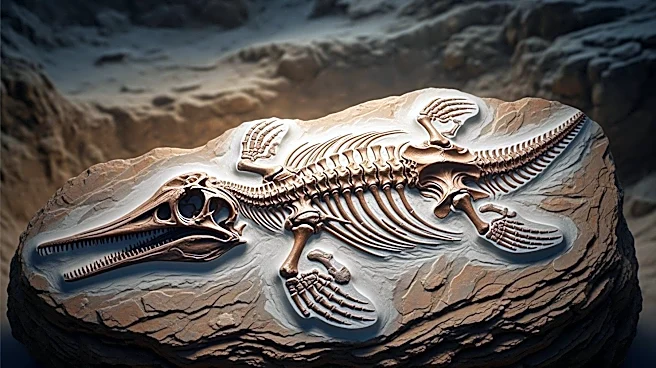
A fossil that had been stored in a museum for decades has been identified as a new species of mosasaur, named Tylosaurus rex. This prehistoric predator, which lived around 80 million years ago, was discovered in Texas and is believed to have been a dominant
marine predator of its time. The fossil was initially misclassified as a different species, Tylosaurus proriger, but further examination revealed significant differences in the skull, jaw, and teeth, indicating a new species. The Tylosaurus rex was a massive creature, measuring up to 43 feet in length, and showed evidence of violent interactions with its own kind. This discovery was made by paleontologist Amelia Zietlow and her team, who reclassified several other fossils previously thought to belong to T. proriger as T. rex.
Why It's Important?
The identification of Tylosaurus rex as a distinct species has significant implications for the understanding of mosasaur evolution. It challenges previous assumptions about the diversity and evolutionary history of these marine reptiles. The discovery highlights the importance of revisiting and re-evaluating existing fossil collections with modern techniques. This could lead to further discoveries and a better understanding of prehistoric marine ecosystems. The reclassification of these fossils also provides new insights into the mosasaur family tree and their geographical distribution during the Cretaceous period.
What's Next?
The discovery of Tylosaurus rex may prompt paleontologists to re-examine other fossil collections for potential misclassifications. This could lead to the identification of additional new species and a more comprehensive understanding of marine life during the Cretaceous period. Researchers may also explore the ecological roles of T. rex and its interactions with other marine species. The findings could influence future paleontological research and methodologies, encouraging the use of advanced technologies in fossil analysis.