






What's Happening?
Matthew Hollingworth, Assistant Executive Director of the World Food Programme (WFP), led a field mission to South Sudan, where he described the country as facing a "collision of crises." The mission, which included Eric Perdison, WFP Regional Director for
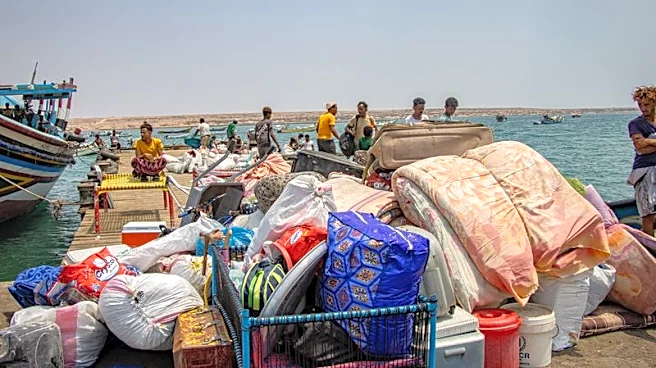
Eastern Africa, Mutinta Chimuka, WFP Country Director, and colleagues from UNHCR, IOM - UN Migration, and UNICEF, visited Renk and Canal/Pigi. In Renk, a border town, they met refugees and returnees fleeing the conflict in Sudan. In Canal/Pigi, a flood-prone area in Jonglei State, they observed the devastating impact of rising waters on livelihoods and agriculture. The mission gathered firsthand accounts from individuals like Hapsa Hassan, a mother of four who walked over 200 kilometers to safety, and a woman in Canal/Pigi whose land was rendered unusable by floods. These stories underscored the profound challenges faced by the population due to conflict, displacement, and climate change.
Why It's Important?
The WFP's field mission and Hollingworth's assessment of a "collision of crises" in South Sudan are critically important for understanding the complex humanitarian challenges in the region. For the U.S., this highlights the multifaceted nature of international aid and foreign policy. The combination of conflict, displacement, and climate change creates a severe humanitarian crisis that demands significant international attention and resources. U.S. foreign aid, often directed towards humanitarian relief and development, must contend with these intertwined issues. The situation in South Sudan demonstrates how climate change can exacerbate existing conflicts and vulnerabilities, leading to mass displacement and food insecurity. This necessitates a comprehensive approach from the U.S. and other international donors, integrating climate resilience, conflict resolution, and humanitarian assistance to address the root causes of suffering and prevent further destabilization, which could have broader geopolitical implications.
What's Next?
The findings from the WFP's field mission are expected to inform future humanitarian strategies and funding allocations for South Sudan. International organizations, including the WFP, UNHCR, IOM, and UNICEF, will likely use these firsthand accounts to advocate for increased support and more integrated interventions. Governments, including the U.S., will face pressure to provide sustained and coordinated aid that addresses both immediate humanitarian needs and long-term solutions for peacebuilding and climate adaptation. This could involve increased financial commitments, diplomatic efforts to resolve conflicts, and technical assistance for climate-resilient agriculture and infrastructure. The stories collected during the mission will serve as powerful tools to raise global awareness and mobilize resources, potentially leading to a re-evaluation of current aid frameworks to better tackle complex, overlapping crises.
Beyond the Headlines
The "collision of crises" in South Sudan, as identified by the WFP, reveals a deeper systemic issue where environmental degradation and climate change act as threat multipliers, intensifying existing conflicts and vulnerabilities. This situation challenges the traditional separation of humanitarian aid, development, and peacebuilding efforts, suggesting that these areas must be addressed concurrently. The ethical implications are profound, as the international community grapples with its responsibility to protect populations from both man-made and natural disasters. Culturally, the resilience observed in the affected communities, despite immense suffering, offers valuable insights into human adaptability and the importance of local agency in recovery efforts. This long-term shift could lead to a more integrated and holistic approach to global challenges, recognizing that environmental, social, and political factors are inextricably linked and require coordinated, multi-sectoral responses.