

What's Happening?
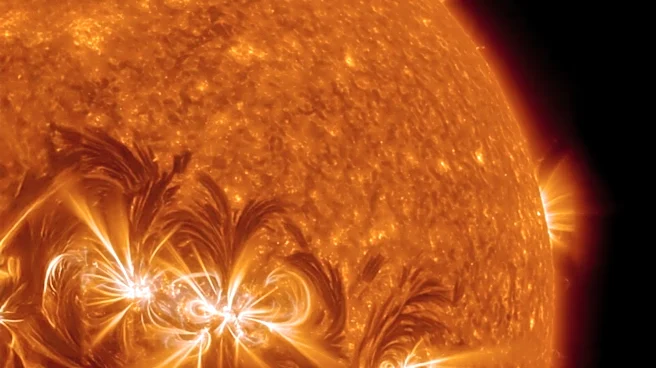
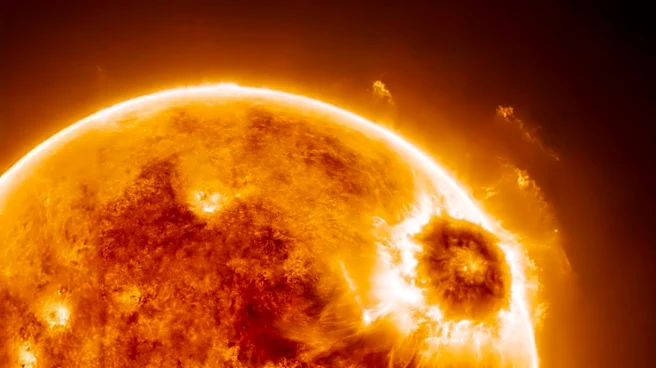
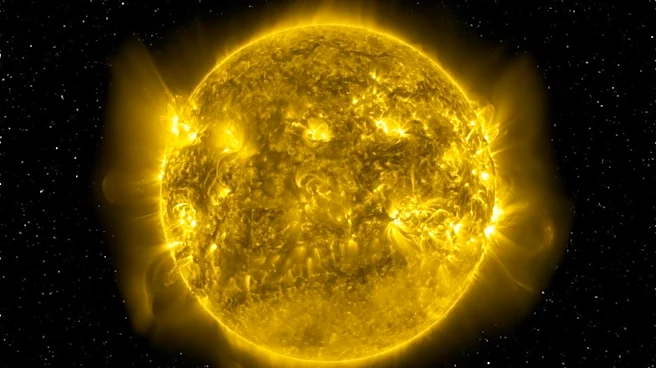
Researchers from the U.S. National Science Foundation National Solar Observatory, the Max Planck Institute for Solar System Research, and the High Altitude Observatory have discovered previously unseen plasma vortices on the Sun's surface. Using the NSF
Daniel K. Inouye Solar Telescope, the world's largest solar telescope, they captured images revealing tiny structures that could explain how the Sun stores, moves, and releases magnetic energy. These vortices, appearing along the boundaries of solar granules, are believed to be evidence of Kelvin-Helmholtz instabilities, a phenomenon in fluid dynamics. The discovery could provide clues to how the Sun's magnetic field lines become twisted, potentially leading to energy release through magnetic reconnection.
Why It's Important?
The discovery of these plasma vortices is significant as it may help scientists understand the mechanisms behind the Sun's magnetic energy storage and release. This understanding is crucial for predicting solar activity, which can impact space weather and, consequently, satellite operations and communication systems on Earth. The vortices could also offer insights into the Sun's magnetic cycle, which influences solar phenomena like sunspots and solar flares. By understanding these processes, scientists can better anticipate and mitigate the effects of solar activity on technology and infrastructure.