







What's Happening?
U.S. Army Under Secretary Mike Obadal has identified a significant transformation in modern warfare, largely influenced by ongoing conflicts in Iran and Ukraine, and the tense situation in the Indo-Pacific. These conflicts have dramatically increased
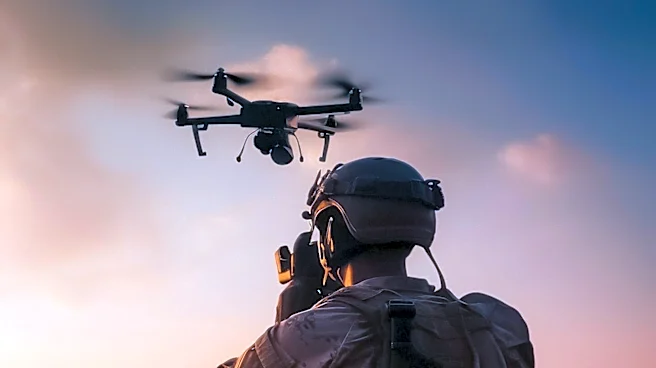
the demand for both advanced, 'exquisite' munitions and cost-effective systems, particularly interceptors, to counter threats like drones. Obadal noted the stark cost-per-kill ratios, citing an instance where a PAC-3 interceptor costing significantly more was used against a much cheaper Shahed-136 drone. This shift also encompasses the rapid integration of artificial intelligence (AI) and unmanned systems into military formations, compelling a re-evaluation of fundamental concepts like concealment, which was less critical during periods of U.S. air superiority. The Pentagon is simultaneously implementing new policies to streamline the acquisition process, aiming to accelerate the development and deployment of new capabilities to the battlefield. Obadal, a former Special Operations officer, emphasizes that his military and private sector experiences inform, rather than dictate, his approach to overseeing the Army's business operations, acquisition strategy, and personnel systems.
Why It's Important?
This 'noticeable shift in warfare' has profound implications for U.S. defense strategy, industrial policy, and technological development. The increased demand for both high-end and low-cost munitions necessitates a rebalancing of the defense industrial base, potentially driving investment in new manufacturing capabilities and supply chains. The emphasis on AI integration and unmanned systems will accelerate technological innovation within the defense sector, creating opportunities for U.S. tech companies but also raising ethical and operational questions about autonomous warfare. The re-evaluation of acquisition processes aims to reduce bureaucratic delays, which could lead to faster deployment of cutting-edge technologies to U.S. forces and allies, enhancing their competitive edge. However, this acceleration also entails accepting more risk in development and deployment. The focus on counter-drone systems and long-range precision fires reflects a strategic adaptation to contemporary threats, influencing future defense budgets and research priorities. This evolution in warfare also impacts U.S. foreign policy, as the effectiveness of military aid and alliances will increasingly depend on the ability to provide and integrate these new capabilities.
What's Next?
The U.S. Army's priorities, as reflected in procurement and budget allocations, will continue to emphasize counter-UAS technologies, advanced software and sensors for decision advantage, and a diversified fires portfolio including long-range precision munitions. Events like the AUSA exposition will showcase these investment areas, highlighting the rapid pace of innovation. The Army will continue to work with commercial industry to experiment and prototype new capabilities, aiming to compress the acquisition cycle. This involves encouraging private capital investment in defense markets and accepting calculated risks to field technologies more quickly. Discussions with tech companies will focus on ensuring the 'human-in-the-loop' element remains central, particularly for kinetic kill chains, while leveraging AI for complex tasks like mission planning and automating dangerous or mundane activities. The Army will also adapt its strategies for concealment and dispersion of assets, moving away from large, centralized headquarters to more disaggregated, technologically advanced systems. The ongoing conflicts will continue to serve as critical learning grounds, informing future adaptations in doctrine, training, and equipment.
Beyond the Headlines
The shift described by Under Secretary Obadal points to a fundamental redefinition of military power and operational paradigms. The emphasis on cost-per-kill ratios highlights an economic dimension to modern conflict, where the affordability of defensive measures against mass-produced, inexpensive threats becomes a critical factor. This could drive a new wave of innovation in low-cost, high-volume defense solutions, potentially democratizing access to advanced military capabilities. The rapid integration of AI and unmanned systems raises profound ethical and legal questions regarding accountability, decision-making autonomy, and the nature of combat. The 'human-in-the-loop' principle, while currently a default, will face increasing pressure as AI capabilities advance. Furthermore, the need to rethink basic concepts like 'hiding' due to advancements in precision targeting and space-based surveillance underscores a broader vulnerability in an increasingly transparent battlespace. This necessitates not just technological solutions but also a re-evaluation of military culture, training, and strategic thinking to adapt to a world where traditional advantages are eroding. The U.S. Army's response to these challenges will shape its future effectiveness and its role in global security.