






What's Happening?
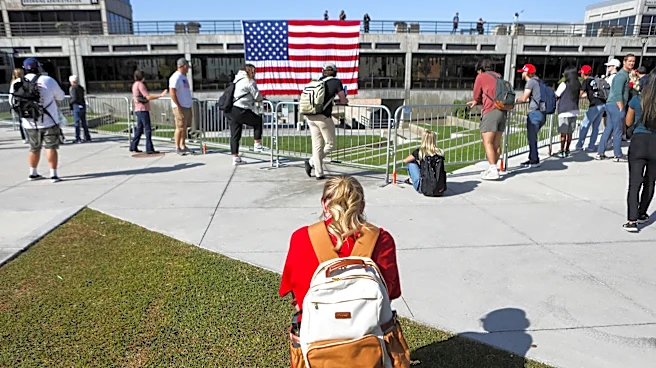
Over 100 faculty and community members at Auburn University protested the Board of Trustees' decision to dissolve the university senate. The dissolution occurred in June with minimal notice to faculty, despite the state law (HB 580) that prompted the action
explicitly exempting Auburn and the University of Alabama. Psychology professor Tracy Witte and history professor Heidi Hausse, organizers of the protest, expressed concerns that the move signals faculty are no longer considered part of the 'Auburn family' and creates a 'climate of fear' on campus. The faculty senate, a representative body, has been replaced by the Presidential Academic Advisory Council (PAAC), which is not independent and serves a strictly advisory role, with many members appointed by the university president.
Why It's Important?
This development at Auburn University is significant for higher education governance and academic freedom. The dissolution of a faculty senate, especially when the enabling state law does not apply to the institution, raises questions about shared governance principles and the role of faculty in academic decision-making. The shift from an elected, representative body to an appointed advisory council could diminish faculty influence over curriculum, academic standards, and university policy. This could impact the quality of education, as faculty expertise might be sidelined in favor of administrative directives. The 'climate of fear' described by professors suggests potential chilling effects on open discourse and critical inquiry, which are fundamental to a robust academic environment. This situation could set a precedent for other universities regarding the balance of power between governing boards and academic staff.
What's Next?
Faculty and community members at Auburn University are expected to continue advocating for greater faculty involvement in university governance. The newly formed Presidential Academic Advisory Council (PAAC) will begin its work, with some members appointed and others to be elected. The university's provost, Vini Nathan, has indicated that new mandated courses, including 'U.S. History and Civic Leadership,' will be required for incoming freshmen by Fall 2027 and Fall 2028, with the Board of Trustees having final approval over the curriculum. The ongoing tension between faculty and the Board of Trustees could lead to further protests, legal challenges, or internal university reforms as stakeholders attempt to redefine the scope of faculty influence and shared governance.
Beyond the Headlines
The situation at Auburn University highlights a broader national trend of increased scrutiny and intervention by state legislatures and governing boards into university affairs, particularly concerning curriculum and faculty autonomy. This can be seen as part of a larger cultural and political debate over the purpose and direction of higher education. The concern that political appointees are controlling curriculum decisions, as voiced by Professor Hausse, suggests a potential erosion of academic independence and the professional judgment of educators. This could lead to a standardization of educational content that prioritizes certain ideological perspectives over comprehensive academic inquiry, potentially impacting the critical thinking skills and intellectual breadth of students. The 'climate of fear' also points to challenges in maintaining an environment where faculty feel secure in expressing diverse viewpoints, which is crucial for academic innovation and intellectual growth.