



What's Happening?
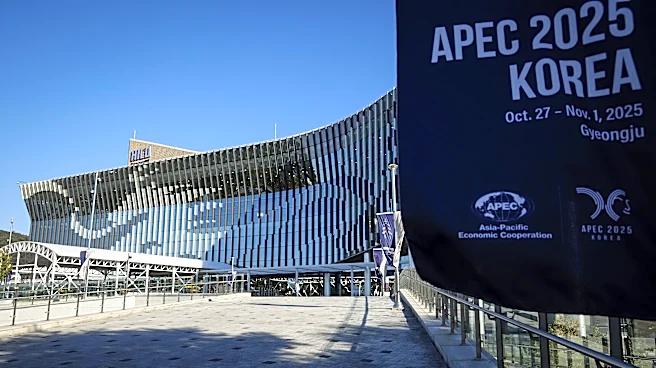
President Lee Jae-myung, during his visit to Shenzhen, China, for the Asia-Pacific Economic Cooperation (APEC) summit, emphasized the urgent need for international collaboration to address the ongoing supply chain crisis. He highlighted the importance
of establishing systems for early identification of supply chain risks and ensuring a stable supply and demand of critical minerals and energy. Speaking at the APEC CEO Summit, President Lee noted that recent geopolitical and supply chain disruptions have underscored the deep interconnectedness of economic systems and industrial structures across the Asia-Pacific region. He stressed that addressing security and economic instability in any single nation is a shared responsibility for all. President Lee also advocated for continued openness despite rising trade barriers and proposed expanding the benefits of the artificial intelligence (AI) revolution to foster 'innovation for all,' urging for flexible and pragmatic approaches to expand intra-APEC trade and investment.
Why It's Important?
President Lee's call for international cooperation on critical minerals and energy supply directly impacts U.S. economic and national security interests. The U.S. relies heavily on global supply chains for these essential resources, and disruptions can lead to increased costs, manufacturing delays, and vulnerabilities in strategic industries. His emphasis on shared responsibility and interconnectedness highlights the global nature of these challenges, suggesting that unilateral actions may be insufficient. For U.S. businesses, particularly those in technology, manufacturing, and energy sectors, stable access to critical minerals and energy is paramount for innovation and competitiveness. Geopolitical tensions, as noted by President Lee, can exacerbate these supply chain fragilities, making international agreements and collaborative risk management crucial for maintaining economic stability and preventing inflationary pressures. The push for 'innovation for all' through AI also signals a potential shift in global technological leadership and economic opportunities, which the U.S. will need to navigate strategically.
What's Next?
The international community, including the U.S., is likely to face increasing pressure to engage in multilateral discussions and agreements concerning critical mineral and energy supply chains. This could involve developing new frameworks for resource sharing, joint investment in extraction and processing technologies, and enhanced intelligence sharing on potential supply disruptions. President Lee's advocacy for expanding intra-APEC trade and investment suggests a potential for increased regional economic integration, which could influence global trade patterns and U.S. trade policies. Furthermore, the integration of AI into industrial processes, as highlighted by South Korea's 'Manufacturing AX' initiative, indicates a future where technological cooperation will be vital for supply chain resilience. The U.S. will need to consider its role in these evolving international collaborations to secure its access to critical resources and maintain its technological edge.
Beyond the Headlines
President Lee's remarks underscore a fundamental re-evaluation of globalization, moving from an era focused solely on efficiency to one prioritizing resilience and security. The interconnectedness he describes implies that economic stability is no longer a purely national concern but a collective one, requiring a shift in diplomatic and economic strategies. The emphasis on critical minerals and energy also highlights the growing competition for finite resources, potentially leading to new geopolitical alignments and rivalries. The role of AI in this context suggests that technological leadership will be intertwined with supply chain control, raising ethical questions about equitable access to advanced technologies and the potential for digital divides. This broader context suggests a future where economic policy, national security, and technological development are inextricably linked, demanding comprehensive and collaborative international responses.