

What's Happening?
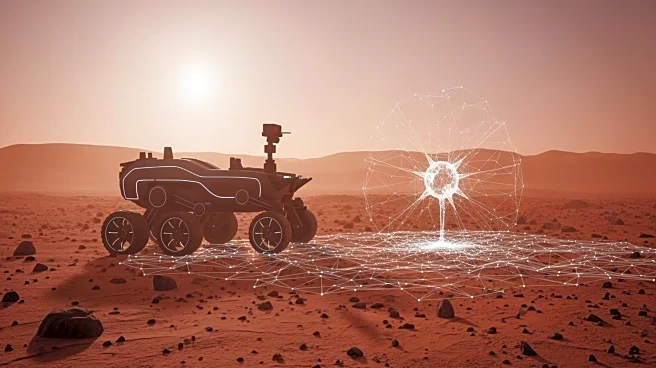
NASA's Perseverance Mars rover has successfully completed its first drive on Mars that was entirely planned by artificial intelligence. This milestone was achieved during two test drives conducted on December 8 and December 10, 2025. The AI-driven navigation
allowed the rover to traverse nearly 1,500 feet across the rugged Martian terrain without manual input from Earth-based planners. This development marks a significant advancement in autonomous space exploration, as it automates a process traditionally handled by human mission teams. The AI utilized data from the Mars Reconnaissance Orbiter and terrain-slope models to identify obstacles and plan a safe route, which was then executed by the rover. The project was led by NASA's Jet Propulsion Laboratory in collaboration with Anthropic, using the company's Claude AI models.
Why It's Important?
The successful implementation of AI in planning rover routes on Mars represents a major leap forward in space exploration technology. By reducing the need for human intervention in route planning, missions can operate more efficiently and respond more swiftly to hazardous conditions. This capability is particularly crucial given the communication delays between Earth and Mars, which make real-time control impossible. The use of AI could significantly increase the scientific return of missions by allowing rovers to cover greater distances and explore more challenging terrains. This advancement not only enhances the efficiency of current missions but also sets a precedent for future explorations of distant planets and moons, potentially reducing costs and increasing the scope of scientific discovery.
What's Next?
Following this successful demonstration, NASA is likely to continue integrating AI technologies into its Mars exploration missions. The agency may expand the use of AI to other aspects of rover operations, such as identifying scientifically interesting features or optimizing energy use. As AI technology continues to evolve, it could play a critical role in the planning and execution of more complex missions, including those involving human exploration. The success of this AI-driven drive could also encourage other space agencies and private companies to adopt similar technologies, potentially leading to more collaborative and innovative approaches to space exploration.