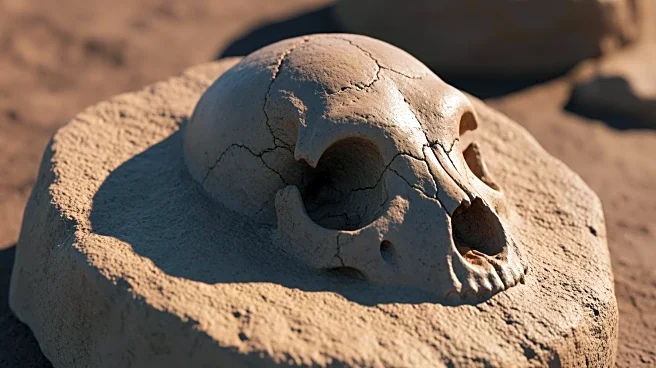




What's Happening?
A new study published in Science Advances suggests that Sahelanthropus tchadensis, a primate from North Africa dating back 7 million years, is a likely candidate for the earliest hominin ancestor. The study, led by Scott Williams of New York University,
reanalyzed the femur of Sahelanthropus and identified a femoral tubercle, a feature associated with bipedalism. This finding supports the hypothesis that Sahelanthropus was capable of walking upright, distinguishing it from apes that walk on all fours. The research builds on previous studies and suggests that Sahelanthropus may have been one of the first species to exhibit traits of bipedalism, a hallmark of hominins.
Why It's Important?
The identification of Sahelanthropus as a potential early hominin ancestor provides crucial insights into human evolution. Understanding the origins of bipedalism helps scientists trace the evolutionary path that led to modern humans. This discovery could reshape the timeline and narrative of human evolution, offering a clearer picture of how early hominins adapted to their environments. The study also highlights the importance of reexamining existing fossil evidence with new techniques, which can lead to significant breakthroughs in paleontology and anthropology.