





What's Happening?
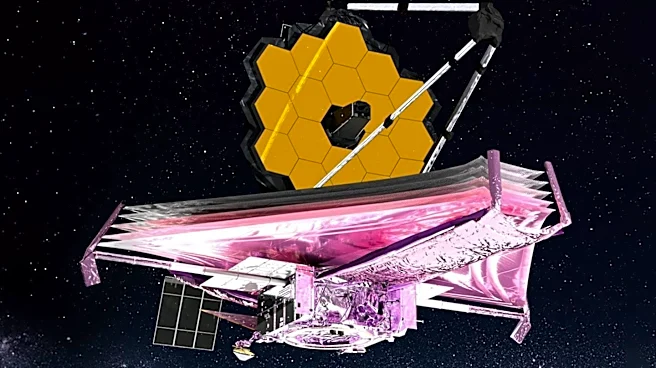
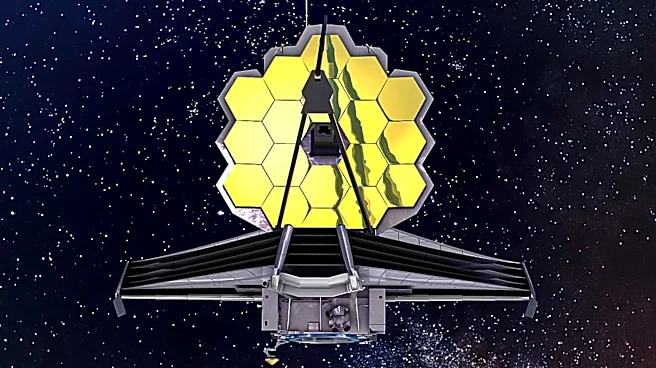
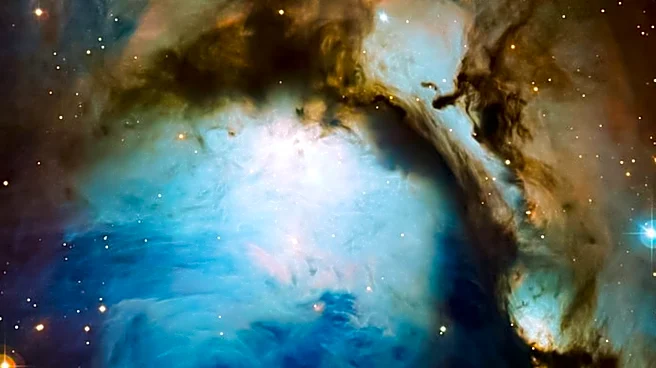
The James Webb Space Telescope has captured a striking image of a star-forming region in the Carina Nebula, located 7,500 light-years away in the constellation Carina. This region, known as the Treasure Chest, features dense clouds of gas and dust that
form a cometary globule with a dense center and a long, sweeping tail. The glow from the newborn stars inside is visible due to Webb's Near-Infrared Camera, which can penetrate the dust. The image reveals approximately 70 young stars within the cluster, including an O-type star with a mass 19 times that of the Sun. The cluster's age is estimated to be around 1.3 million years. The powerful ultraviolet radiation from nearby large stars is affecting the circumstellar disks around these young stars, potentially impacting planet formation.
Why It's Important?
This observation is significant as it provides insights into the processes of high-mass star formation and the early stages of stellar evolution. The Carina Nebula is one of the closest regions where astronomers can study these phenomena in detail. Understanding the impact of radiation on circumstellar disks is crucial for comprehending how planets form and evolve in such environments. The data collected by the James Webb Space Telescope will help scientists determine whether these young stars have the potential to form planets or if they will remain isolated due to the harsh conditions. This research contributes to the broader understanding of star and planet formation in the universe.
What's Next?
The observing program led by Megan Reiter of Rice University aims to map over 100 new jets across the Carina region, providing a comprehensive understanding of how young stars interact with their surroundings. The program will continue to analyze the data to explore how these stars collect gas and expel it in massive outflows. This research will enhance our knowledge of the dynamics within star-forming regions and the factors influencing planet formation. The findings could have implications for identifying potential habitable zones in other star systems.