


What's Happening?
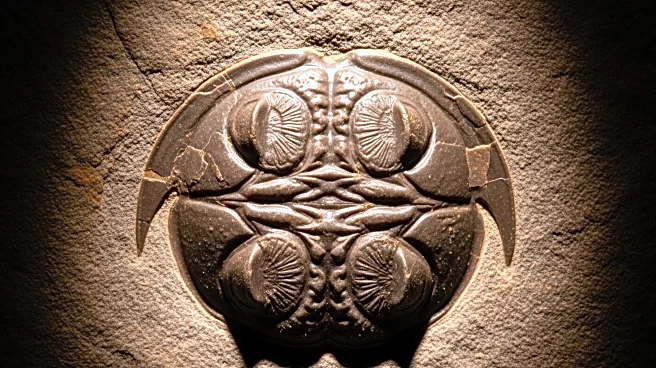
Recent discoveries of Cambrian fossils have revealed that some of the earliest vertebrate ancestors may have had four eyes. These findings come from the Chengjiang biota, a collection of fossils dating back approximately 518 million years. The fossils,
which include jawless fish, show preserved soft body parts and eyes, suggesting that these ancient creatures had a broad view of their surroundings and could see objects in high resolution. Researchers, including Karma Nanglu from the University of California Riverside, are interested in further mapping these fossils to confirm whether the second set of eyes is a genuine feature or an artifact of fossilization. The study highlights the complexity of eye evolution, indicating that complex eyes evolved independently in several animal groups.
Why It's Important?
This discovery is significant as it provides new insights into the evolution of vertebrates and the development of complex visual systems. Understanding the evolutionary history of eyes can shed light on how modern vertebrates, including humans, perceive the world. The presence of four eyes in these ancient vertebrates suggests that early vertebrates had a more complex visual system than previously thought, which could have been advantageous in the diverse and predator-rich Cambrian seas. This research could influence future studies on the evolution of sensory organs and contribute to the broader understanding of vertebrate evolution.
What's Next?
Further research is needed to confirm the presence of four eyes in these ancient vertebrates. Detailed mapping of the fossils could provide more evidence and help determine whether the additional eyes were functional or a result of fossilization processes. The scientific community may engage in debates regarding the interpretation of these findings, as some researchers, like Tetsuto Miyashita from the Canadian Museum of Nature, express skepticism. Continued exploration of the Chengjiang biota and similar fossil sites could uncover more evidence to support or refute these claims.