



What's Happening?
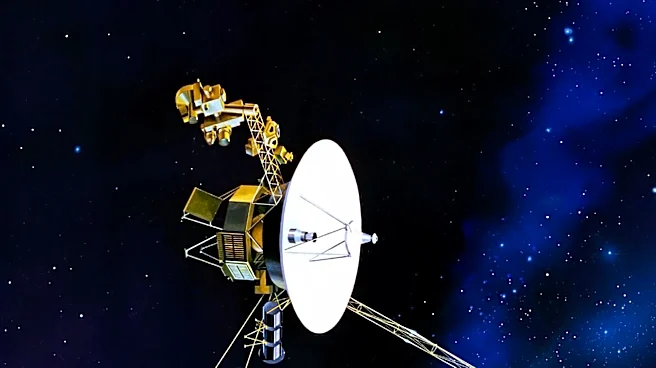
NASA's Voyager 1, launched in 1977, remains the most distant human-made object in space, currently situated about 25 billion kilometers from Earth. The spacecraft is so far that a radio signal traveling at the speed of light takes over 22 hours to reach
it. Despite its distance, Voyager 1 continues to send data back to Earth from interstellar space, powered by a nuclear source that now produces less electricity than a couple of household light bulbs. The spacecraft crossed into interstellar space in 2012, becoming the first to do so, and has been providing valuable scientific data about the plasma and magnetic fields in this region. NASA has been managing the spacecraft's dwindling power supply by shutting down non-essential systems to prolong its operational life, with the aim of keeping it functional into the 2030s.
Why It's Important?
Voyager 1's continued operation and data transmission are significant for several reasons. It provides unique insights into interstellar space, a region beyond the influence of the Sun, which is crucial for understanding the broader cosmos. The data collected helps scientists study the boundary of the solar system and the nature of the interstellar medium. Additionally, Voyager 1's endurance highlights the durability and longevity of space technology, offering lessons for future deep-space missions. The mission also symbolizes human curiosity and the quest for knowledge, as it continues to explore regions of space that were previously unreachable, expanding our understanding of the universe.
What's Next?
As Voyager 1 approaches a milestone where its signal will take a full 24 hours to reach Earth, expected around November 2026, NASA will continue to manage its power supply carefully. The spacecraft's power is expected to last into the 2030s, but as its nuclear power source continues to decay, more systems will need to be shut down. The focus will remain on maximizing the scientific return from the remaining operational instruments. The mission's progress will be closely monitored by NASA, and any new findings from Voyager 1 will contribute to our understanding of interstellar space.