






What's Happening?
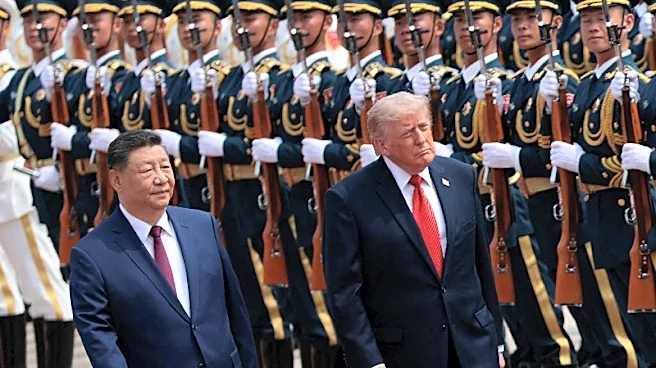
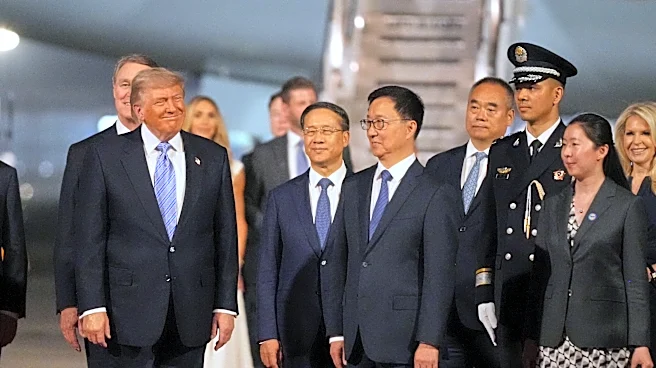
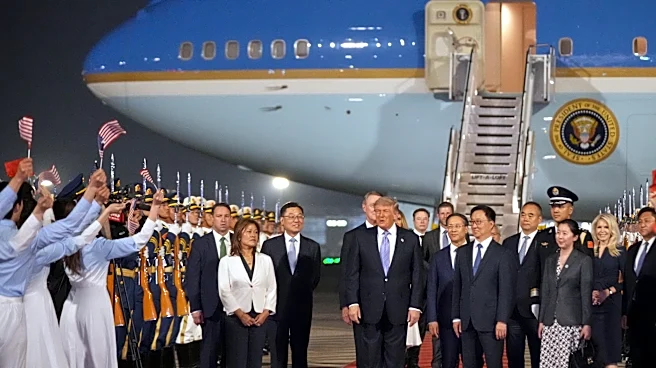
President Trump and Chinese leader Xi Jinping concluded a summit in Beijing, where Trump referred to the meeting as the 'G-2,' likening it to the Group of Seven (G7) but focused on the U.S. and China. The summit was marked by pageantry and discussions
aimed at portraying the two nations as equal superpowers. Analysts noted that Xi achieved a long-sought goal of presenting China as an equal to the U.S. on the global stage. The summit included discussions on trade, with Trump announcing a deal for China to purchase 200 Boeing jets and potential agreements on U.S. agricultural products. However, no firm commitments were made on several issues, including the U.S. standoff with Iran. The meeting also touched on human rights issues, with Trump raising the case of a detained pastor. The summit's framing as a 'G-2' event reflects a shift in geopolitical dynamics, with China seeking to assert itself as a peer to the U.S.
Why It's Important?
The summit's portrayal of the U.S. and China as equal superpowers has significant implications for global geopolitics. It signals a potential shift in the balance of power, with China asserting itself more prominently on the world stage. This development could impact U.S. foreign policy and its relationships with allies, particularly in Asia, where countries like Japan are closely monitoring the U.S.-China dynamic. The trade agreements discussed could have economic implications, particularly for U.S. industries like agriculture and aerospace. However, the lack of firm commitments on key issues such as Iran and Taiwan suggests ongoing uncertainties in U.S.-China relations. The summit also highlights the broader tension between the two nations, as they navigate complex issues like trade, human rights, and regional security.
What's Next?
Following the summit, both nations are expected to continue high-level discussions on trade and other strategic issues. The U.S. may seek to solidify agreements on agricultural exports and aerospace deals, while China will likely continue to push for recognition as a global superpower. The summit's outcomes may influence future U.S. policy decisions, particularly regarding trade and military strategy in the Asia-Pacific region. Additionally, the framing of the U.S. and China as equal powers could prompt reactions from other global players, potentially reshaping alliances and diplomatic strategies.