




What's Happening?
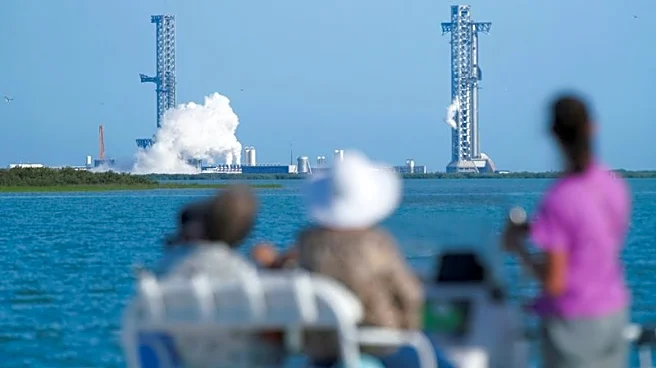
China has successfully launched the Shenzhou 23 spacecraft from the Jiuquan Satellite Launch Center in northwestern China. The mission includes three astronauts: Zhu Yangzhu, Zhang Zhiyuan, and Lai Ka-ying, who is the first astronaut from Hong Kong to
participate in a space mission. The launch is part of China's broader space exploration efforts, which include plans for a crewed lunar landing by 2030. The crew is tasked with conducting numerous scientific and application projects aboard the Tiangong space station. Notably, one astronaut is set to remain in space for a year, marking one of the longest single stays in space. This mission aims to explore human adaptability and performance limits in long-duration spaceflight environments.
Why It's Important?
This mission underscores China's growing ambitions in space exploration, positioning it as a significant player alongside the United States. The inclusion of Lai Ka-ying, the first astronaut from Hong Kong, highlights China's efforts to integrate diverse regions into its national space program. The yearlong stay of one astronaut will provide valuable data on human endurance in space, potentially influencing future long-duration missions, including those to the Moon and Mars. As China continues to develop its space capabilities, it challenges the dominance of the U.S. in space exploration, particularly as NASA plans its own lunar missions by 2028.
What's Next?
Following the successful launch, the Shenzhou 23 crew will conduct an in-orbit rotation with the Shenzhou 21 crew, who have been at the Tiangong space station for over 200 days. The mission's outcomes could influence China's future space endeavors, including its planned lunar landing. The data collected from the yearlong stay will be crucial for planning extended missions, potentially paving the way for China's participation in international space collaborations or further independent missions.
Beyond the Headlines
China's exclusion from the International Space Station due to U.S. national security concerns has driven it to develop its own space station, Tiangong, which translates to 'Heavenly Palace.' This self-reliance in space infrastructure could lead to increased geopolitical influence as China offers its space station for international collaborations. The mission also reflects China's strategic use of space exploration to foster national pride and technological advancement, potentially inspiring future generations of scientists and engineers.