
What's Happening?
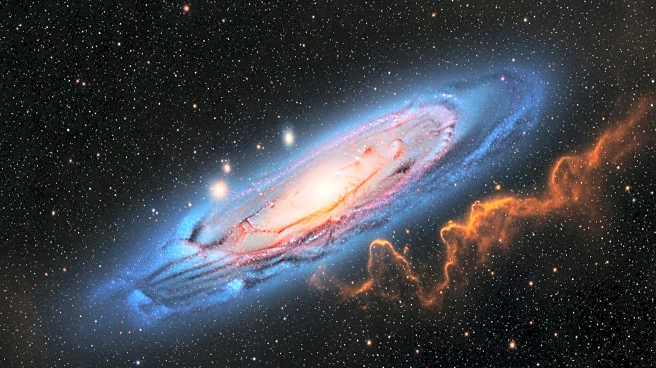
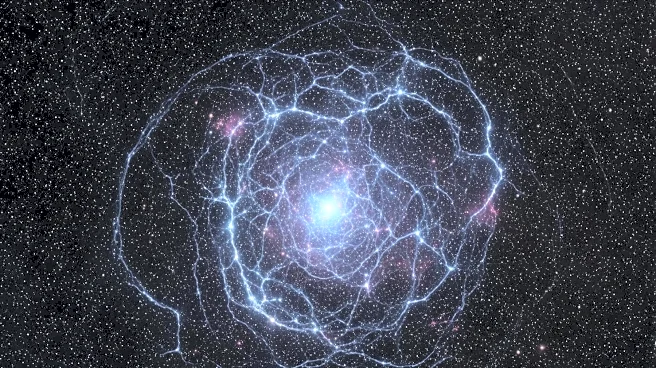
The James Webb Space Telescope (JWST) has unveiled a new image showcasing a dense cluster of galaxies in the constellation Sculptor, demonstrating the universe's structure shortly after the Big Bang. The image,
captured by JWST's Near-Infrared Camera, reveals a 'web of chaos' where gas, dust, and newly forming stars interlace. This observation highlights how matter organizes under gravity, with tiny fluctuations in density growing into massive structures. JWST's infrared capabilities allow it to see through cosmic dust, revealing the inner workings of stellar nurseries and capturing light that has traveled for over 13 billion years.
Why It's Important?
This discovery provides unprecedented insights into the early universe's structure and the processes that led to the formation of galaxies. By observing the cosmic web, scientists can better understand the role of dark matter and dark energy in shaping the universe. The ability to capture such detailed images of the early universe allows researchers to reconstruct a timeline of cosmic evolution, offering clues about the universe's expansion and the formation of large-scale structures. This knowledge is crucial for refining models of the universe's development and understanding the forces that govern its dynamics.
What's Next?
Researchers are analyzing the data from JWST to explore the influence of dark matter and dark energy on the growth of cosmic structures. Future studies will focus on mapping the cosmic web in greater detail, using JWST's capabilities to observe galaxies that existed shortly after the Big Bang. This research will help answer fundamental questions about the universe's appearance and the movement of galaxies through space. As JWST continues its observations, it is expected to uncover more about the universe's early stages, providing a deeper understanding of its origins and evolution.