



What's Happening?
The team responsible for developing and mastering the landing capability of SpaceX's Falcon 9 rocket has been awarded the first-ever Neil Armstrong Space Prize. The award, created by Purdue University, recognizes the team's significant contributions to
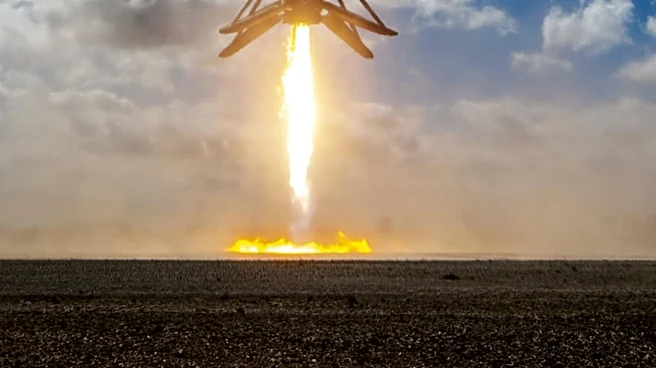
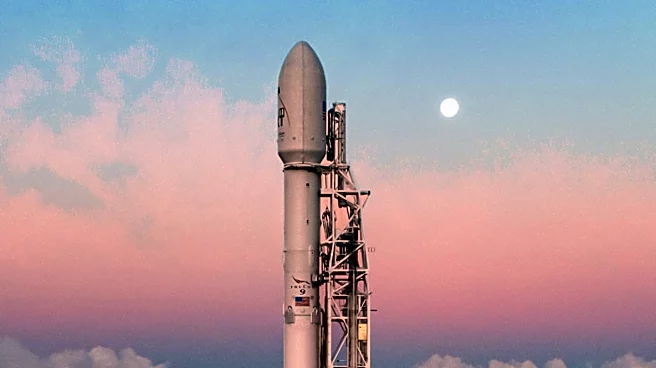
making rocket reuse practical and scalable. The prize was presented during a ceremony at the Cosmos Club in Washington, D.C. The inaugural honorees include five SpaceX employees: Lars Blackmore, Shana Diez, Jon Edwards, Yoshiaki Kuwata, and Eduardo Velazquez, representing the larger Falcon 9 landing team. The Falcon 9, which debuted in June 2010, was designed with a reusable first stage, a goal that took several years to achieve. The first successful vertical touchdown of a Falcon 9 first stage occurred on December 21, 2015, at Florida's Cape Canaveral Air Force Station, followed by a successful landing on a drone ship in the Atlantic Ocean on April 8, 2016. These advancements have led to over 650 booster landings during orbital missions to date.
Why It's Important?
The recognition of the Falcon 9 landing team with the Neil Armstrong Space Prize underscores the transformative impact of reusable rocket technology on the space industry. By making rocket reuse practical at an unprecedented scale, SpaceX has fundamentally altered the economics of spaceflight. This innovation has significantly reduced launch costs, opening new possibilities for scientific research, space exploration, and commercial ventures. The ability to reuse rocket boosters multiple times, with some Falcon 9 first stages having flown over 30 times, has made the Falcon 9 the dominant launch vehicle globally. This success has also inspired other nations and companies to pursue similar reusable rocket technologies, fostering a more competitive and innovative space sector. The prize highlights the importance of engineering ingenuity and perseverance in pushing the boundaries of space technology, ultimately contributing to a more accessible and sustainable spacefaring economy.
What's Next?
SpaceX plans to eventually phase out the Falcon 9 in favor of its fully reusable Starship megarocket, which is currently under development. Starship is designed to facilitate human settlement on the Moon and Mars, among other ambitious exploration goals. While the Falcon 9's first stage is reusable, its upper stage is expendable. The Starship system aims for full reusability, including its upper stage, known as Ship. SpaceX has already achieved successful recovery of Starship's Super Heavy first stage on three occasions during test flights. The next major challenge involves successfully landing and re-flying Starship's upper stage. The company anticipates further testing and refinement will be necessary to achieve this, drawing on the extensive experience gained from the Falcon 9 program. The continued development of Starship represents the next frontier in reusable spaceflight, promising even greater reductions in launch costs and expanded capabilities for deep space missions.
Beyond the Headlines
The achievement of practical rocket reusability by SpaceX, as recognized by the Neil Armstrong Space Prize, signifies a profound shift in humanity's approach to space. Historically, space launches were incredibly expensive due to the single-use nature of rockets. The ability to reuse these complex machines not only lowers costs but also promotes a more sustainable model for space exploration, reducing the amount of space debris and resource consumption. This paradigm shift has broader implications for the development of a spacefaring civilization, making ambitious projects like lunar bases and Martian colonies more economically viable. The spirit of innovation and the willingness to tackle seemingly insurmountable engineering challenges, as demonstrated by the Falcon 9 team, are crucial for advancing scientific and technological frontiers. This success story also serves as an inspiration for future generations of engineers and scientists, encouraging them to pursue bold ideas that can reshape our future.