




What's Happening?
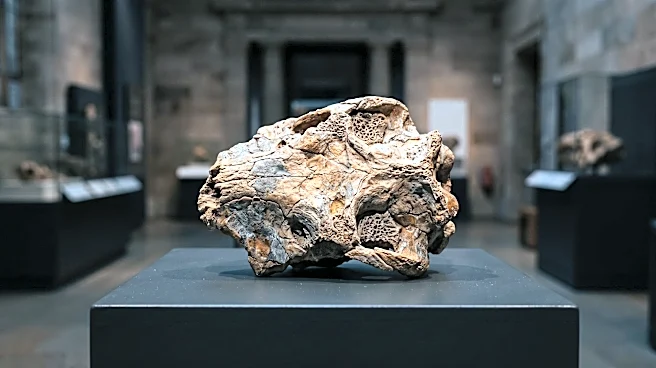
Researchers from the Chinese Academy of Sciences have conducted a palaeoproteomic analysis of two bone fragments found in northern China, linking the ancient human remains from Xujiayao to the Denisovan lineage. This study, published in the journal *Nature*
on October 21, 2026, utilized protein analysis to identify 18 ancient proteins, with a significant finding being the COL1A2-996 R>K amino acid substitution in collagen, which is characteristic of Denisovans. This molecular identification allowed researchers to compare the cranial, mandibular, and dental features of the Xujiayao collection with other confirmed or putative Denisovan finds in East Asia. The Xujiayao site, located in the Nihewan Basin, yielded 20 fragments of skulls, jaws, and teeth between 1976 and 1979, with strata dating back approximately 199,000–138,000 years ago. This research provides a more accurate description of Denisovan skull and facial morphology.
Why It's Important?
This study is crucial for understanding the physical characteristics and geographical distribution of Denisovans, an ancient human lineage previously identified primarily through ancient DNA and limited bone fragments. For a long time, the anatomical understanding of Denisovans was less developed than their genetic relationships. The Xujiayao finds, with their more preserved skull and jaw parts, combined with molecular confirmation, significantly enhance our knowledge of Denisovan morphology. The research characterizes Denisovans as individuals with a low skull profile, relatively parallel lateral walls of the cranial vault, a prominent brow ridge, a flat zygomatic-maxillary region, and a slight protrusion of the lower face. These findings reinforce the view that Denisovans were widely distributed across East Asia and help to differentiate them from Neanderthals and early Homo sapiens, while also noting some shared ancient features with Homo erectus.
What's Next?
The study's findings open avenues for further research into the morphological diversity within the Denisovan lineage. While the current research provides a clearer picture of skeletal features, it does not allow for the determination of soft tissue characteristics like skin, hair, or eye color, nor the extent of variation among different Denisovan populations. Future studies will likely focus on confirming the Denisovan origin of other morphologically similar Middle Pleistocene finds from East Asia, such as specimens from Jingniushan, Dali, and Hualongdong, through direct molecular evidence like DNA or ancient proteins. This will help to solidify the understanding of Denisovan distribution and their evolutionary relationships with other ancient human groups.
Beyond the Headlines
The ability to link ancient human remains to specific lineages through palaeoproteomic analysis represents a significant advancement in paleoanthropology. This method provides a powerful tool for classifying fossils when DNA is not well-preserved, offering insights into evolutionary history that were previously unattainable. The discovery of Denisovan characteristics in the Xujiayao collection, dating back nearly 200,000 years, underscores the deep and complex history of human migration and interaction across Asia. It challenges previous classifications of these remains and highlights the ongoing process of refining our understanding of human origins. The study also implicitly raises questions about the potential for interbreeding and cultural exchange between different hominin groups in the region, given the presence of both ancient and later Homo genus traits in Denisovan morphology.