
What's Happening?
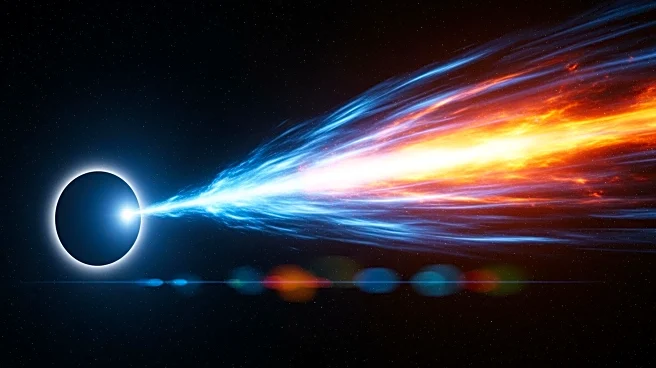
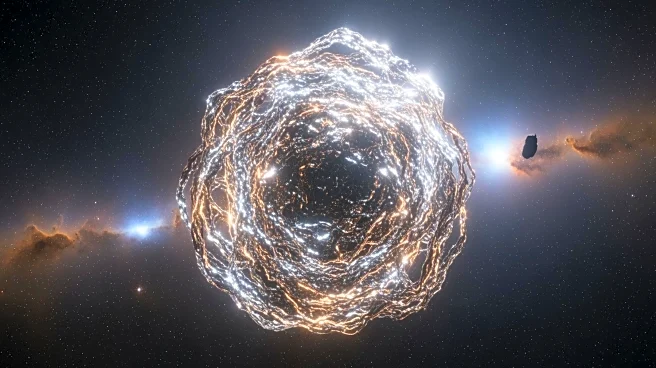
Astronomers have discovered a massive cloud of vaporized metals that is blocking the light of a distant star, identified as J0705+0612, located approximately 3,000 light-years away. This cloud, which could be bound to either a large planet or a small
star, presents a rare opportunity for scientists to study its composition and movement. The discovery was made in September 2024 when the star's brightness decreased by 40 times for about nine months, before returning to normal in May 2025. The cloud, estimated to be about 120 million miles in size, is believed to be held together by the gravity of another object orbiting the star, potentially several times the mass of Jupiter. This phenomenon is considered extremely rare, especially given the system's estimated age of 2 billion years.
Why It's Important?
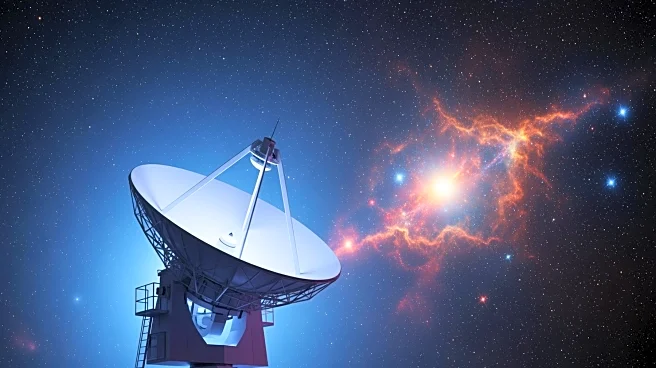
This discovery is significant as it provides a unique opportunity to study the dynamics and composition of such clouds in space, which are rarely observed. The findings could enhance our understanding of planetary formation and the processes that occur in older star systems. The ability to measure the speed and composition of the gas within the cloud using advanced spectroscopic techniques marks a breakthrough in astronomical research. This could lead to new insights into the lifecycle of stars and the formation of celestial bodies, potentially impacting theories about the evolution of planetary systems.
What's Next?
Further observations and analyses are likely to be conducted to determine the exact nature of the object holding the cloud together. Researchers may continue to use advanced telescopes and spectroscopic tools to gather more data on the cloud's composition and movement. This could involve international collaboration among astronomers to explore similar phenomena in other star systems, potentially leading to new discoveries about the universe's structure and the processes governing celestial mechanics.
Beyond the Headlines
The discovery raises questions about the processes that can lead to such massive clouds forming around older star systems, challenging existing models of planetary system evolution. It also highlights the importance of continuous observation and the role of advanced technology in uncovering hidden aspects of the universe. The findings could inspire further research into the potential for similar occurrences in other parts of the galaxy, contributing to a deeper understanding of cosmic events and their implications for the broader field of astronomy.