






What's Happening?
A recent study published in *Nature Communications* details the development of a sterically regulated electrolyte (SRCE) designed to improve the safety and durability of high-energy lithium metal batteries. Researchers introduced a non-flammable cyclic
fluorinated diluent, 1,1,2,2,3,3,4-heptafluorocyclopentane (HFC), which organizes electrolyte components into isolated solvation nanoclusters. This innovative approach aims to overcome the inherent reactivity of lithium metal and nickel-rich layered-oxide electrodes, which typically lead to side reactions, electrolyte consumption, and the formation of hazardous lithium dendrites. The HFC diluent weakens undesirable interactions between lithium ions, anions, and solvent molecules, preserving strong cation-anion coordination and promoting smaller, isolated nanoclusters. This structure facilitates improved lithium-ion transport and suppresses large-scale aggregation, leading to more uniform lithium deposition and enhanced electrode protection. The study utilized computational modeling, structural, chemical, and electrochemical characterization, including density functional theory (DFT) calculations and molecular dynamics (MD) simulations, to validate the electrolyte's design and performance.
Why It's Important?
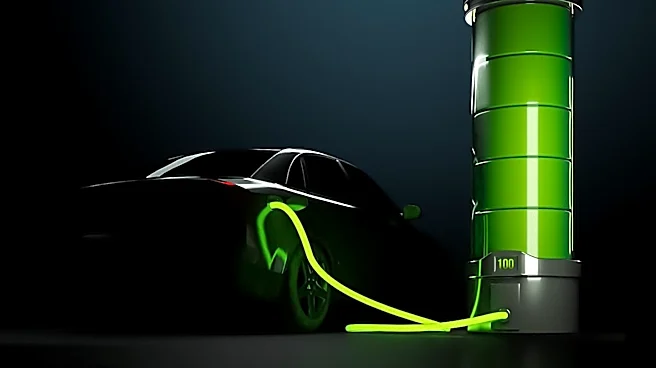
This development is crucial for advancing battery technology, particularly for electric vehicles (EVs) and large-scale grid energy storage in the U.S. Lithium metal batteries offer significantly higher specific energies (above 500 Wh kg⁻¹) compared to current lithium-ion batteries, making them highly desirable for applications requiring extended range and greater energy capacity. However, safety concerns, primarily due to lithium dendrite formation and electrolyte flammability, have hindered their widespread adoption. The new SRCE electrolyte addresses these critical issues by promoting stable lithium deposition and forming robust, thin interphases that protect both the lithium metal anode and the nickel-rich cathode. This not only extends battery cycle life but also enhances safety, as demonstrated by tests showing no sparks or explosions during nail penetration and stable behavior during severe overcharge. For the U.S. energy sector and automotive industry, this could translate into more reliable, safer, and higher-performing energy storage solutions, accelerating the transition to electric transportation and renewable energy grids.
What's Next?
The findings suggest a promising pathway for the commercialization of safer and more energy-dense lithium metal batteries. Future steps will likely involve scaling up the production of the HFC diluent and the SRCE electrolyte for larger-format battery cells, moving beyond coin and pouch cell configurations to practical EV battery packs. Further research will focus on optimizing the electrolyte composition and manufacturing processes to ensure cost-effectiveness and long-term stability under various operating conditions. Collaboration between academic institutions and industrial partners will be essential to translate these laboratory-scale successes into market-ready products. Additionally, regulatory bodies may need to establish new safety standards and testing protocols for these advanced battery chemistries. The success of this technology could lead to increased investment in domestic battery manufacturing and research, bolstering the U.S.'s position in the global battery market and energy independence.
Beyond the Headlines
Beyond the immediate performance and safety benefits, this research highlights a fundamental shift in battery design philosophy—focusing on nanoscale engineering of electrolyte structures. By precisely controlling molecular interactions within the electrolyte, researchers are unlocking new avenues for optimizing battery performance that go beyond traditional material selection. This approach could inspire similar innovations in other electrochemical systems, potentially leading to breakthroughs in fuel cells, supercapacitors, and other energy conversion devices. The emphasis on reducing electrolyte consumption and extending cell life also aligns with broader sustainability goals, as it could lower the material footprint per unit of energy delivered, contributing to a more circular economy for battery production. This deeper understanding of electrolyte microstructure could also inform the development of solid-state electrolytes, further enhancing battery safety and energy density in the long term, thereby revolutionizing portable electronics and grid-scale energy storage.