






What's Happening?
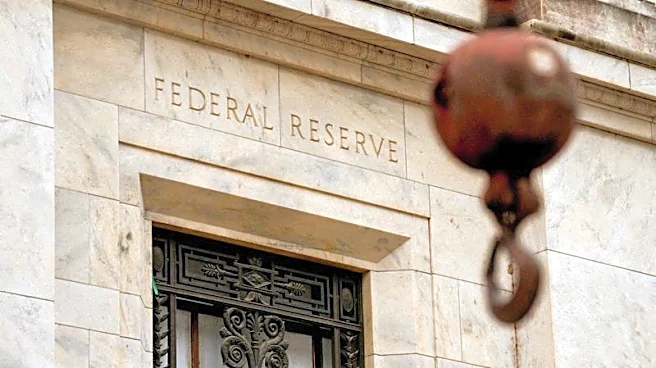
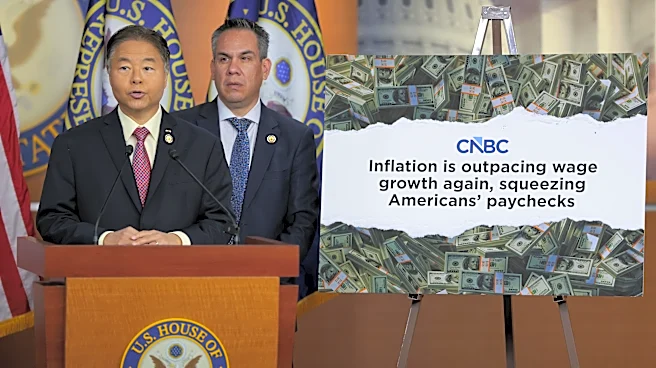
The Federal Reserve is under increasing pressure to implement more aggressive interest rate hikes as inflation continues to rise faster than expected. The latest Consumer Price Index (CPI) showed a 0.4% increase in October, marking the third consecutive
month of higher-than-anticipated price rises. This trend is attributed to supply constraints and strong economic demand, according to EY-Parthenon chief economist Gregory Daco. Analysts from BofA Global Research and TD Securities now anticipate multiple quarter-point rate increases in December, January, and March. Fed Governor Christopher Waller has even suggested considering a 0.50 percentage-point increase in December to maintain the central bank's credibility. High energy prices and robust corporate spending on AI infrastructure are identified as key drivers keeping inflation elevated, potentially into 2027, and impacting household purchasing power.
Why It's Important?
The Federal Reserve's response to persistent inflation has significant implications for the U.S. economy and consumers. More aggressive interest rate hikes will lead to a higher cost of borrowing across various consumer loans, impacting everything from mortgages to credit cards. This increased cost of borrowing could dampen consumer spending and investment, potentially slowing economic growth. For businesses, higher interest rates mean increased financing costs, which could affect expansion plans and profitability. The Fed's credibility is also at stake, as failure to bring inflation in line with its 2% annual target could erode public trust in its ability to manage the economy. The broadening nature of price pressures, as noted by TD Securities, suggests that inflation is not confined to a few sectors but is becoming a more systemic issue, making the Fed's task more challenging.
What's Next?
Interest rate traders are currently placing high odds on a quarter-point hike at the Fed's December meeting, with a strong possibility of another in January. Analysts from BofA Global Research and TD Securities are forecasting three consecutive quarter-point hikes through March. The Federal Reserve's Federal Open Market Committee (FOMC) will closely monitor upcoming inflation reports and economic data to determine the exact pace and magnitude of future rate adjustments. The ongoing impact of high energy prices and corporate AI spending will also be critical factors influencing their decisions. Consumers and businesses should prepare for a sustained period of higher borrowing costs as the Fed attempts to curb inflation and steer the economy towards its 2% target.
Beyond the Headlines
The current inflationary environment highlights a complex interplay of factors, including supply chain disruptions, strong demand, and emerging technological influences like AI. The robust corporate spending on data centers and AI equipment, while indicative of technological advancement, is also contributing to inflationary pressures by driving up demand and prices in certain sectors. This suggests that inflation is not solely a monetary phenomenon but also has structural components related to global supply chains and technological shifts. The challenge for the Fed extends beyond traditional monetary policy tools, as it must navigate these multifaceted drivers of inflation without stifling economic innovation or triggering a recession. The long-term implications could include a re-evaluation of global supply chain resilience and the economic impact of rapid technological adoption.