







What's Happening?
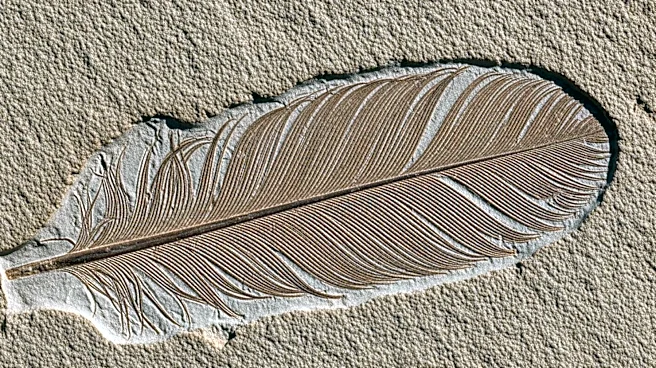
In 1996, a fossil discovered in China provided the first confirmed evidence of a dinosaur with feathers, significantly impacting the scientific understanding of dinosaur evolution. This discovery supported the hypothesis that some dinosaurs developed
feathers and eventually evolved into modern birds. Canadian palaeontologist Philip Currie was among the first to study the specimen, which sparked considerable debate within the scientific community. The fossil, identified as Sinosauropteryx prima, challenged previous notions about dinosaur appearance and behavior, leading to a reevaluation of the evolutionary link between dinosaurs and birds.
Why It's Important?
The confirmation of feathered dinosaurs has profound implications for the field of paleontology and our understanding of evolutionary biology. It supports the theory that birds are the direct descendants of theropod dinosaurs, reshaping the evolutionary tree. This discovery has influenced how scientists reconstruct the appearance and behavior of dinosaurs, impacting both academic research and public perception. The finding also highlights the importance of international collaboration in scientific research, as access to fossils in China was initially challenging for Western researchers. This breakthrough has paved the way for further discoveries and research into the evolutionary history of birds.