







What's Happening?
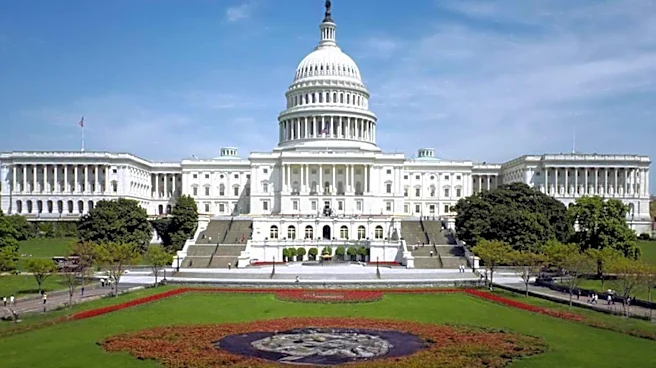
An increasing number of congressional staffers and members of Congress are utilizing artificial intelligence (AI) tools, such as Copilot, ChatGPT, Gemini, and Claude, for official legislative work. Both the House and Senate have cleared the use of these
chatbots, with the House having purchased 6,000 Microsoft Copilot licenses last year, approximately half of which are currently in use. While broad guidelines are in place, prohibiting the input of sensitive material, generation of deepfakes, personnel decisions, and finalization of legislation, individual offices are encouraged to implement their own AI policies. This has resulted in a varied set of standards across Capitol Hill, leading to concerns about the potential impact on the legislative process and the quality of laws being crafted.
Why It's Important?
The growing reliance on AI in Congress carries significant implications for U.S. policymaking and governance. While AI can streamline workflow, there is a tangible fear of losing critical knowledge and skill in legislative drafting. Every word and punctuation mark in a law is intentional and carries specific meaning, and over-reliance on chatbots could lead to a diminished understanding among lawmakers and staff regarding the full impact of the laws they create. This shift could introduce errors, unintended consequences, or ambiguities into legislation, potentially affecting various sectors of society, industries, and the economy. The lack of uniform AI policies across congressional offices also creates inconsistencies and potential vulnerabilities, raising questions about the integrity and precision of future U.S. laws.
What's Next?
The increasing use of AI in Congress will likely necessitate a more standardized and robust framework for its implementation. Discussions are expected to continue regarding the balance between leveraging AI for efficiency and maintaining the human expertise essential for crafting precise and impactful legislation. Congress may need to develop more comprehensive and mandatory guidelines for AI use, potentially including training programs for staff and members on ethical AI application and critical evaluation of AI-generated content. There could also be a push for independent oversight or auditing mechanisms to ensure compliance with AI usage policies and to assess the quality of AI-assisted legislative output. The long-term trajectory will depend on how effectively Congress addresses the challenges of maintaining legislative integrity while embracing technological advancements.
Beyond the Headlines
The integration of AI into the legislative process raises profound ethical and philosophical questions about the nature of governance and the role of human intellect in lawmaking. The potential for AI to 'hallucinate' or produce inaccurate information, as seen in other professional fields, could undermine public trust in the legislative process. Furthermore, the ease with which AI limitations, such as the prohibition on political requests, might be circumvented, points to deeper issues of accountability and transparency. This development could fundamentally alter the skills required for congressional staff, potentially de-emphasizing critical thinking and detailed legal analysis in favor of AI proficiency. The long-term shift could lead to a legislative landscape where the nuances of legal language are increasingly shaped by algorithms, with unforeseen consequences for democratic principles and the rule of law.