
What's Happening?
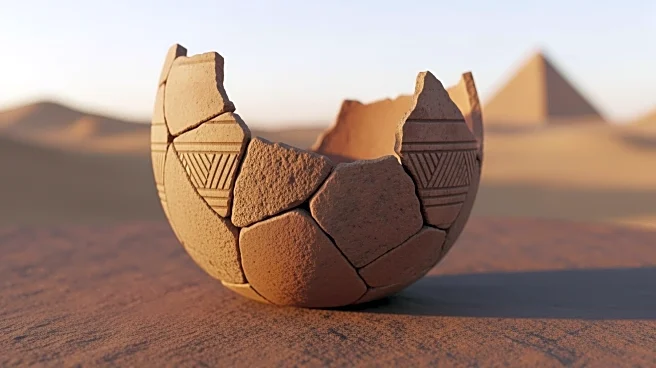
Researchers from Liverpool John Moores University and the Francis Crick Institute have uncovered a significant archaeological find in Nuwayrat, Egypt. A rock tomb containing a ceramic pot with human bones
was discovered, preserving ancient DNA due to the cool microclimate of the burial chamber. This DNA, carbon-dated to between 2855 and 2570 BCE, represents a complete genome, a rarity in paleogenetic studies. The genetic analysis revealed that the individual, a man who died at around 60 years old, had a genome composition of 80% North African and 20% Mesopotamian ancestry. This suggests migratory movements from Western Asia to Egypt during that period, indicating a deeper connection between these regions beyond mere trade.
Why It's Important?
This discovery is pivotal for understanding the genetic history and migratory patterns of ancient civilizations. The presence of Mesopotamian genetic markers in an Egyptian individual provides evidence of early human migration and cultural exchange between North Africa and Western Asia. This could reshape historical narratives about the development of early civilizations and their interactions. For paleogeneticists, the ability to analyze DNA from nearly 5,000 years ago opens new avenues for research into the origins and evolution of human societies. It also highlights the potential for future discoveries that could further illuminate the complex web of ancient human migrations.
What's Next?
The researchers emphasize that while this discovery is significant, it represents only a single data point. Further excavations and genetic analyses are necessary to confirm the extent of these migratory patterns and their impact on the development of Egyptian civilization. Future studies could focus on finding additional burial sites with preserved DNA to build a more comprehensive picture of ancient human movements. This could lead to a reevaluation of historical connections between ancient civilizations and provide insights into the cultural and genetic exchanges that shaped early human history.