


What's Happening?
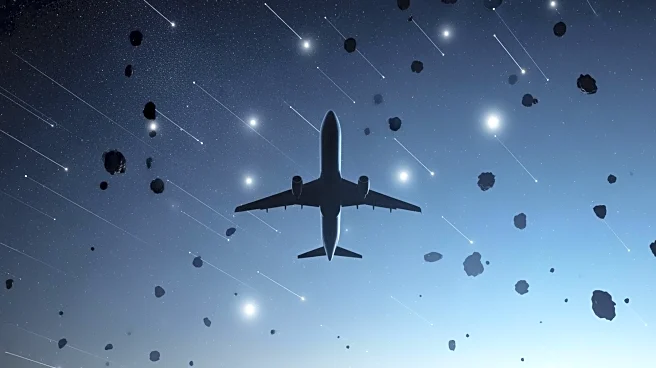
The risk of space debris impacting airplanes is rising, according to experts. Space debris, which includes spent rocket stages and defunct satellites, frequently re-enters Earth's atmosphere. While most debris burns up upon re-entry, some fragments can
survive and pose a risk to aircraft. A study from the University of British Columbia suggests a 26% chance that space debris will fall through busy airspace in the coming year. By 2030, the likelihood of a commercial flight encountering space debris could be 1 in 1,000. The European Space Agency and other organizations are working to better predict and manage these risks, including determining when to close airspace to protect aircraft.
Why It's Important?
The increasing risk of space debris poses significant safety concerns for the aviation industry. With the growing number of satellites and space operations, the potential for debris to impact aircraft is becoming more pronounced. This situation could lead to catastrophic outcomes, given the high number of passengers on commercial flights. The aviation industry, along with space agencies, must develop strategies to mitigate these risks, which could include more precise predictions of debris re-entry and improved communication between space and aviation authorities. The economic implications are also considerable, as airspace closures can lead to significant delays and financial losses.
What's Next?
Efforts are underway to improve the prediction of space debris re-entry and to establish protocols for airspace management. The European Space Agency is conducting studies to determine the risk thresholds for aircraft and to refine the decision-making process for airspace closures. Additionally, international cooperation is essential, as space debris often crosses national borders. Agencies like the FAA and the International Civil Aviation Organization are working with space launch companies to develop more specific airspace closure guidelines. These efforts aim to minimize disruptions while ensuring safety.
Beyond the Headlines
The issue of space debris highlights the need for international collaboration and the development of global standards for space traffic management. As space activities increase, the legal and regulatory frameworks governing space debris will need to evolve. This situation also underscores the importance of designing spacecraft that disintegrate more completely upon re-entry, reducing the risk of debris reaching populated areas or airspace. The ongoing research and development in this field could lead to significant advancements in both space and aviation safety.