





What's Happening?
The European Space Agency (ESA) and the Japan Aerospace Exploration Agency (JAXA) have formalized a partnership to collaborate on the Ramses mission, which aims to study the asteroid Apophis during its close approach to Earth in April 2029. This mission, known
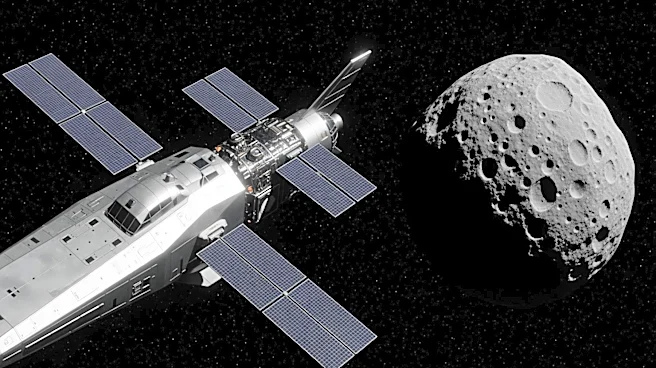
as the Rapid Apophis Mission for Space Safety (Ramses), will involve a spacecraft designed to observe the gravitational effects of Earth on Apophis in real time. The asteroid, approximately 375 meters in diameter, will pass about 32,000 kilometers above Earth's surface, a distance closer than geostationary satellites. JAXA will contribute technical components and launch the probe using its H3 rocket, while ESA will handle spacecraft design and mission operations. This collaboration marks a significant step in planetary defense, providing a unique opportunity to study the physical changes in Apophis as it interacts with Earth's gravity.
Why It's Important?
The Ramses mission is crucial for advancing planetary defense strategies. By observing Apophis during its flyby, scientists can gather data on how tidal forces affect an asteroid's structure and rotation. This information is vital for future asteroid deflection missions, as it will help determine the best methods to alter an asteroid's trajectory if it poses a threat to Earth. The mission also strengthens international cooperation in space exploration, with ESA and JAXA pooling resources and expertise. The public visibility of Apophis during its flyby, potentially observable by two billion people, underscores the importance of planetary defense and could raise awareness and support for future initiatives.
What's Next?
The Ramses mission is on a tight schedule dictated by celestial mechanics, requiring a launch in 2028 to reach Apophis by February 2029. ESA and JAXA must coordinate closely to meet this deadline, with spacecraft assembly and critical design reviews already underway. The mission's success depends on timely political and financial support from ESA member states. Additionally, the mission's public engagement aspect, with potential live broadcasts of the flyby, could enhance public interest and support for planetary defense efforts. The data collected will inform future missions, including NASA's OSIRIS-APEX, which will study Apophis post-flyby.
Beyond the Headlines
The Ramses mission highlights the complexities of planetary defense, where global threats require coordinated international responses. The collaboration between ESA and JAXA exemplifies how space agencies can work together to address shared challenges. The mission also emphasizes the need for rapid response capabilities in space exploration, as the ability to quickly develop and launch missions is crucial for effective planetary defense. The public visibility of Apophis during its flyby presents an unprecedented opportunity to engage the global community in discussions about space safety and the importance of scientific research in protecting Earth from potential asteroid impacts.