





What's Happening?
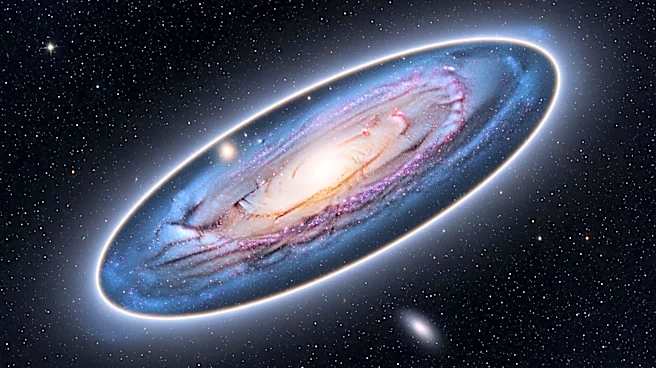
A group of astronomers has identified a collection of 20 stars believed to have originated from a dwarf galaxy named 'Loki' that merged with the Milky Way during its early evolution. These stars are characterized as metal-poor, distinct from other metal-poor stars in the Milky Way's
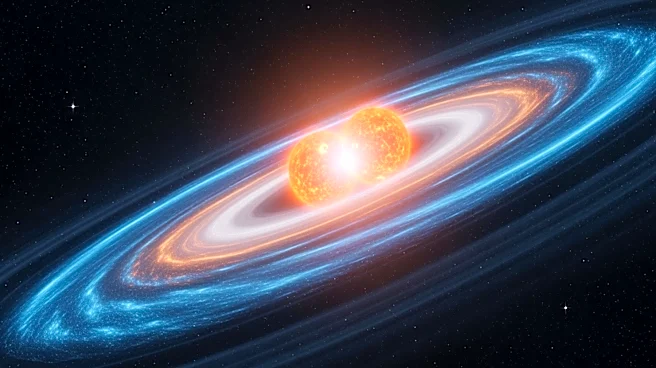
halo. The study, published in the Monthly Notices of the Royal Astronomical Society, suggests that these stars were part of a short-lived, energetic dwarf galaxy. The chemical signatures of these stars indicate enrichment from high-energy supernovae and neutron star mergers, but not from white dwarf explosions. This discovery provides a new perspective on the formation and evolution of the Milky Way.
Why It's Important?
The identification of the 'Loki' galaxy within the Milky Way offers significant insights into the galaxy's formation and the role of dwarf galaxies in its evolution. Understanding the chemical composition and origins of these stars helps astronomers piece together the history of the Milky Way and the processes that have shaped it. This research could lead to a better understanding of galactic formation and the distribution of elements in the universe, impacting theories about the early universe and the development of galaxies.
What's Next?
Future research will likely focus on larger, homogeneous spectroscopic surveys to further investigate the origins of metal-poor stars in the Milky Way. Projects like WEAVE and 4MOST are expected to provide more data, helping to clarify the history and characteristics of these stars. Continued study of these stars could refine models of galactic evolution and improve our understanding of the Milky Way's structure.