







What's Happening?
Melbourne Airport (MEL) is currently undergoing a significant $4.5 billion (AUD) overhaul to modernize its facilities, including new terminals, gates, and a crucial third runway. This expansion is designed to accommodate the city's rapid population growth,
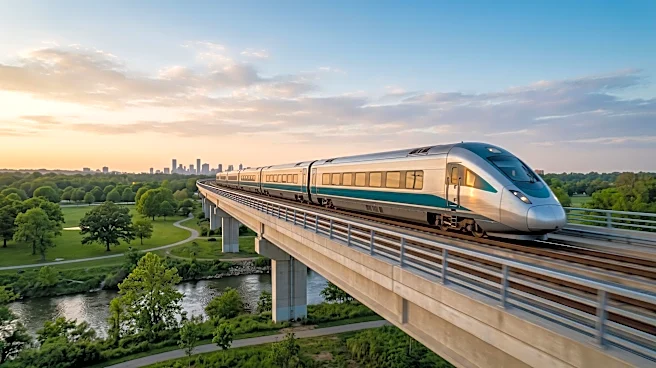
which has seen Melbourne surpass Sydney as Australia's most populous city, now home to over 5.4 million people. In addition to the airport expansion, a $12 billion (AUD) rail project has commenced to finally connect Melbourne Airport to the city's central business district. This rail link aims to alleviate the severe crowding and traffic congestion that has plagued the airport, which has historically relied heavily on road transport. The first phase of the rail project involves untangling and simplifying a six-kilometer section of track, constructing two new rail bridges, an underpass, and realigning passenger and freight lines, with a target completion of 2030. The full rail connection to the airport is anticipated by 2033.
Why It's Important?
This extensive infrastructure investment is critical for Melbourne's continued economic development and its role as a major international hub. The current reliance on road transport for airport access has created significant logistical challenges, impacting both residents and the millions of passengers passing through MEL annually. The expansion of the airport, particularly the addition of a third runway, is essential for increasing flight capacity and accommodating the projected doubling of passenger numbers to 76 million by 2042. This will enhance Melbourne's connectivity to global markets, facilitating trade, tourism, and business travel. The rail link will provide a more efficient and sustainable mode of transport, reducing carbon emissions and improving the overall travel experience. For businesses, improved airport infrastructure means better access to international markets and a more attractive environment for foreign investment. For residents, it promises reduced travel times and less traffic congestion, enhancing quality of life.
What's Next?
The airport overhaul and rail link construction are proceeding in phases. The first stage of the rail project, focusing on track simplification and new stations, is expected to be completed by 2030. The full rail connection to Melbourne Airport, including a new station at Keilor East and a transfer hub at the airport, is targeted for completion by 2033. The third runway at MEL is expected to open in 2031, which will significantly increase the airport's capacity. However, this means there will be a period between 2031 and 2033 where the airport's capacity will increase substantially without the full support of the rail link, potentially exacerbating existing traffic issues. Melbourne's new premier, Ben Carroll, has committed to prioritizing the Airport Rail Link, indicating a strong political will to keep the project on track despite past delays and disagreements regarding station design. The success of these projects will be crucial in determining Melbourne's future as a global city.
Beyond the Headlines
The challenges faced by Melbourne Airport highlight a broader issue in urban planning: the foresight required to anticipate and accommodate rapid population growth and its impact on critical infrastructure. The initial design of Melbourne Airport in 1970, with ample room for expansion, proved prescient, allowing for the current large-scale redevelopment. However, the delay in establishing a rail link underscores the complexities and political hurdles often involved in major infrastructure projects, especially when balancing competing interests and visions. The reliance on cars in post-war Melbourne's design has created a legacy of traffic dependency that these new projects aim to rectify. This transformation represents a shift towards more integrated and sustainable urban transport solutions, acknowledging that a city's growth must be supported by robust and interconnected infrastructure. The ethical considerations of balancing economic growth with environmental impact and community well-being are also at play, as the projects aim to reduce congestion and improve connectivity.