
What's Happening?
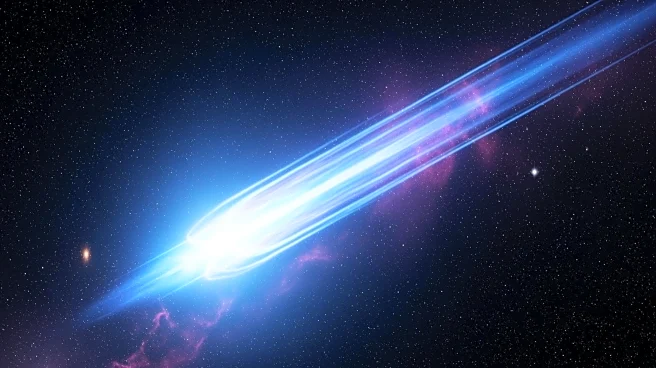
NASA's Fermi Gamma-ray Space Telescope recorded an unusually long gamma-ray burst (GRB) on July 2, 2025, which lasted over seven hours. This event, named GRB 250702B, is the longest-duration GRB ever observed.
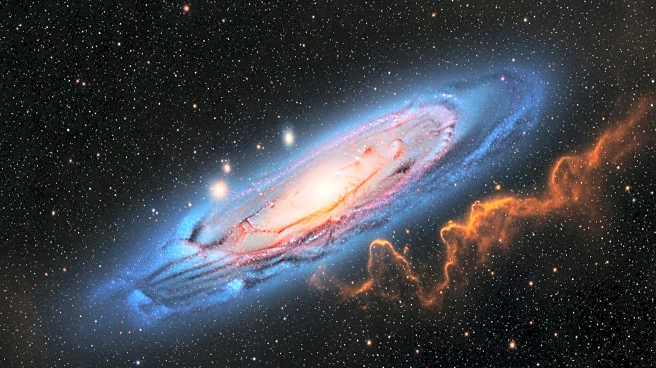
It originated from a massive galaxy 8 billion light-years away in the constellation Scutum. The burst emitted a narrow jet of material traveling at 99% the speed of light. Due to the thick dust in its host galaxy, the GRB was almost invisible in visible light, detectable only in infrared and high-energy X-ray wavelengths. Researchers used various telescopes, including the Gemini telescopes, the Very Large Telescope, and the Hubble Space Telescope, to study the event.
Why It's Important?
The discovery of GRB 250702B challenges existing models of gamma-ray bursts, as its duration and characteristics do not fit current theories. This event provides a unique opportunity for astronomers to study a potentially new type of cosmic explosion. Understanding such phenomena can offer insights into the life cycles of stars and the dynamics of galaxies. The findings could also influence future astronomical research and the development of new models to explain similar cosmic events.
What's Next?
Astronomers will continue to analyze data from GRB 250702B to determine its exact cause. Possible explanations include the death of a massive star, a star being torn apart by a black hole, or the merger of a helium star and a black hole. Future observations of similar events will be compared to GRB 250702B to refine or develop new models of gamma-ray bursts. This ongoing research may lead to a deeper understanding of the universe's most energetic phenomena.