



What's Happening?
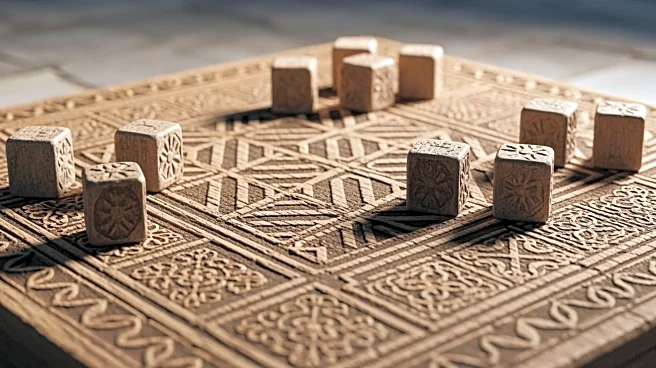
Researchers have utilized artificial intelligence to decode the rules of a mysterious ancient board game, believed to date back to the Roman era. The game was identified from a smooth, white stone unearthed in the Netherlands, which features diagonal
and straight lines. Scientists from Leiden University and Maastricht University collaborated on this project, using 3D imaging and an AI program named Ludii. The AI was trained with the rules of approximately 100 ancient games from the same region, allowing it to generate possible rule sets. The AI then simulated the game, identifying variants that could be enjoyable for human play. The research suggests that the game involved strategic movement to trap the opponent's pieces, using materials like glass, bone, or earthenware as game pieces.
Why It's Important?
This discovery is significant as it provides a glimpse into the recreational activities and cultural practices of ancient Roman society. Understanding the rules and mechanics of such games can offer insights into the social interactions and cognitive skills valued by past civilizations. The use of AI in archaeology represents a growing trend where technology aids in uncovering historical mysteries, potentially leading to more discoveries about ancient cultures. This advancement not only enriches historical knowledge but also demonstrates the potential of AI in fields beyond its traditional applications, such as gaming and entertainment.
What's Next?
The findings have been published in the journal Antiquity, and researchers may continue to explore other ancient artifacts using similar AI techniques. This could lead to further revelations about ancient games and their role in historical societies. Additionally, the methodology could be applied to other archaeological puzzles, potentially transforming the way historians and archaeologists approach ancient artifacts. The success of this project may encourage more interdisciplinary collaborations between technology and humanities, fostering new research opportunities.
Beyond the Headlines
The ethical implications of using AI in archaeology include ensuring that interpretations remain grounded in historical evidence and not overly reliant on algorithmic outputs. As AI becomes more prevalent in historical research, it is crucial to maintain a balance between technological innovation and traditional scholarly methods. This approach can help prevent the misinterpretation of historical artifacts and ensure that cultural heritage is respected and accurately represented.