



What's Happening?
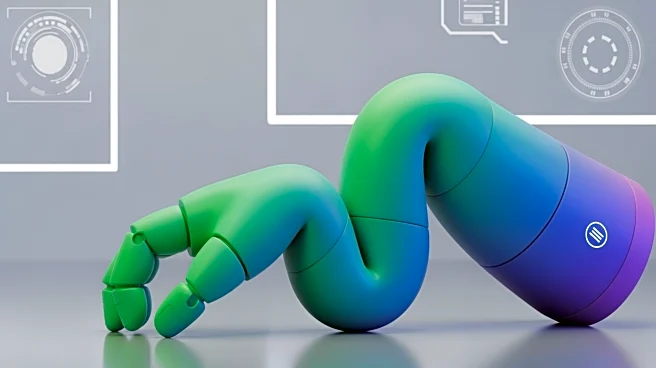
A team of researchers from the Korea Institute of Science and Technology, led by Dae-Yoon Kim, has developed a soft robot named Octoid that mimics the movement and color-changing abilities of an octopus. This innovative robot utilizes photonic crystal
polymers, which are nanostructured materials capable of displaying vibrant colors by reflecting specific wavelengths of light. The Octoid can change colors and move in a flexible manner, controlled by electrical signals that cause microscopic contractions and expansions. This development marks a significant advancement in the field of biomimetic soft robotics, combining the movement and camouflage capabilities of an octopus into a single robotic system.
Why It's Important?
The creation of the Octoid represents a breakthrough in soft robotics, with potential applications across various industries. The ability to mimic the adaptive camouflage and movement of an octopus could revolutionize fields such as marine exploration, military camouflage systems, and medical micro-robotics. The technology could enhance deep-sea rescue operations, improve marine ecology monitoring, and assist in hospital settings by providing robots that can navigate complex environments. The use of photonic crystal polymers in robotics is still emerging, and this development could pave the way for more intelligent, adaptive machines that can operate in diverse and challenging environments.
What's Next?
The research team aims to expand the technology behind Octoid to develop more advanced soft machines that are self-aware and capable of learning. Future applications could include autonomous adaptive robots for various industries, enhancing capabilities in areas such as military operations and medical assistance. The continued exploration of photonic crystal polymers in robotics could lead to further innovations, potentially transforming how robots interact with their environments and perform tasks that require flexibility and adaptability.
Beyond the Headlines
The development of the Octoid highlights the growing interest in biomimicry within robotics, where natural systems inspire technological advancements. This approach not only offers practical solutions but also raises ethical and philosophical questions about the integration of biological principles into artificial systems. As these technologies advance, considerations around the ethical use of biomimetic robots in sensitive areas such as military and healthcare will become increasingly important, necessitating discussions on regulation and responsible innovation.