



What's Happening?
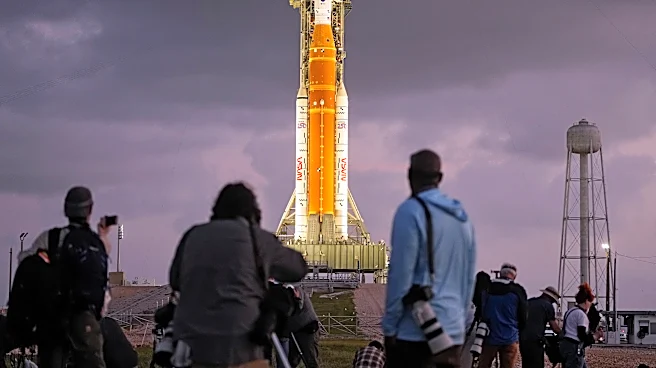
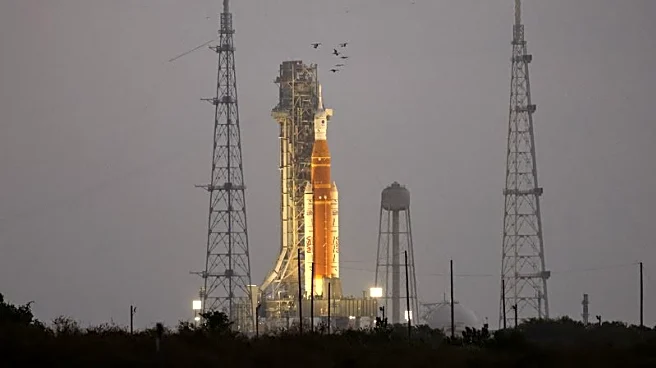
NASA is scaling back Boeing's involvement in the Artemis lunar program by canceling the Boeing-built Exploration Upper Stage (EUS) for the Space Launch System (SLS) Block 1B configuration. This decision is part of NASA's strategy to prioritize affordability
and efficiency by utilizing commercially developed heavy-lift and in-space propulsion systems. The EUS, which was projected to cost approximately $2.8 billion, was intended to enhance the performance of the SLS for future Artemis missions. Instead, NASA will continue using the existing SLS configuration through Artemis V, scheduled for 2029, before transitioning to a different launch model for Artemis VI. Under the new plan, the Orion spacecraft will be launched into Earth orbit on a smaller commercial rocket, where it will dock with SpaceX's Human Landing System (HLS) for propulsion to lunar orbit and back.
Why It's Important?
This shift in NASA's approach significantly impacts Boeing's revenue share from the Artemis program, as SLS launches have been valued in the billions per mission. By opting for commercial alternatives like ULA's Vulcan Centaur, SpaceX's Falcon Heavy, or Blue Origin's New Glenn, NASA aims to reduce costs per mission. This move reflects a broader trend in the space industry towards leveraging commercial capabilities to achieve cost-effective space exploration. It also highlights NASA's commitment to maintaining fiscal responsibility while advancing its lunar exploration goals. The decision could influence future collaborations and contracts within the aerospace sector, potentially affecting the competitive landscape.
What's Next?
Boeing remains the prime contractor for the SLS core stage on Artemis II, which is targeting a launch no earlier than April 1, 2026. This mission will be the first crewed mission to the Moon in over 50 years, involving astronauts Reid Wiseman, Victor Glover, Christina Koch, and Jeremy Hansen. As NASA continues to refine its Artemis program strategy, further adjustments to contractor roles and mission configurations may occur. The agency's focus on affordability and efficiency suggests ongoing evaluations of commercial partnerships and technologies to support its long-term lunar exploration objectives.