




What's Happening?
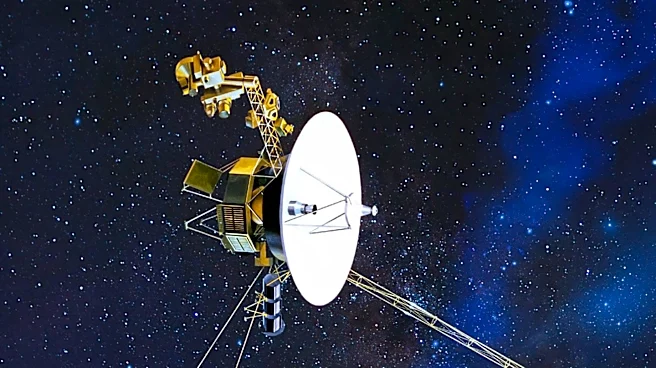
Voyager 1, launched in 1977, remains the most distant human-made object, now over 25 billion kilometers from Earth. It continues to send data back from interstellar space, despite the radio signal taking over 22 hours to reach Earth. The spacecraft operates
on a nuclear power source, which is gradually declining. Currently, it produces less electricity than a couple of household light bulbs. Voyager 1's instruments are still active, studying plasma and magnetic fields, with data transmitted through NASA's Deep Space Network. The spacecraft is approaching a milestone where its signal will take a full 24 hours to reach Earth, expected by November 2026.
Why It's Important?
Voyager 1's ongoing mission provides invaluable data about interstellar space, contributing to our understanding of the solar system's boundary and the environment beyond. Its endurance demonstrates the durability and longevity of 1970s technology, offering insights into long-term space exploration. The mission's success underscores the importance of nuclear power in deep space missions, where solar energy is insufficient. As Voyager 1 continues to operate, it serves as a testament to human ingenuity and the quest for knowledge, inspiring future generations of scientists and engineers.
What's Next?
As Voyager 1 approaches the one light-day milestone, NASA will continue to manage its dwindling power supply by shutting down non-essential systems. The mission's future depends on how long the spacecraft can operate on its decreasing power. Engineers aim to maintain basic data transmission into the 2030s, but the eventual shutdown of instruments is inevitable. This milestone will mark a new chapter in space exploration, as Voyager 1 continues to push the boundaries of human achievement.