





What's Happening?
Indonesia is reportedly exploring the possibility of joining the Mecca Pact, a regional security initiative signed by Turkey, Saudi Arabia, and Pakistan. Turkish officials have indicated Indonesia's interest, citing the close partnership between Ankara
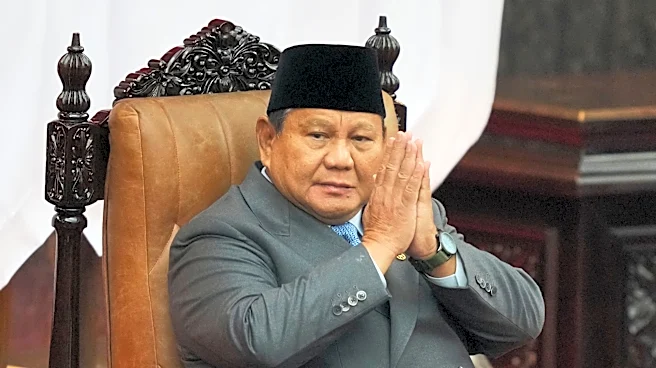
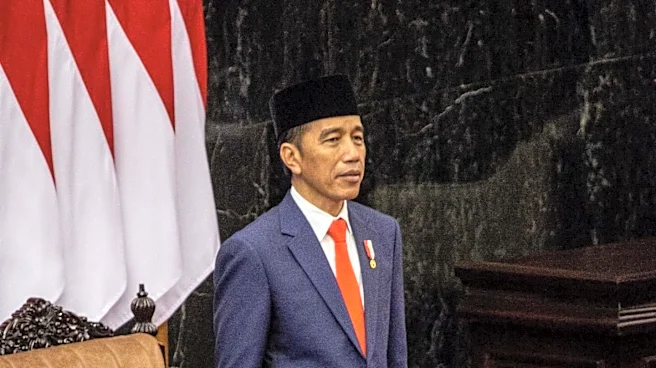
and Jakarta, particularly in defense industry cooperation. This comes after Indonesia signed a $10 billion deal for 48 Turkish Kaan fighter jets and a $1 billion agreement for two Istanbul-class frigates. Additionally, Turkey, Indonesia, Pakistan, and Qatar recently signed the Badr Pact, a memorandum of understanding aimed at deepening defense industry collaboration. However, an Indonesian embassy spokesperson could not confirm this interest, and a Southeast Asia expert, Adinda Khaerani Epstein, noted that Indonesian President Prabowo has reaffirmed the country's commitment to a 'free and active foreign policy' and has no intention of joining military alliances, making membership in the Mecca Pact seem unlikely.
Why It's Important?
Indonesia's potential involvement in the Mecca Pact, despite its geographical distance from the Middle East, highlights a broader shift in global security alignments and Indonesia's evolving foreign policy. For the United States, this development could signal a complexifying geopolitical landscape in Southeast Asia, where Indonesia is a significant player. While Indonesia maintains growing defense cooperation with the U.S., its engagement with initiatives like the Mecca Pact and its pursuit of 'multi-aligned' foreign policy, including engagement with BRICS and OECD membership, suggest a desire to diversify partnerships and maintain strategic independence. This could impact regional power dynamics and potentially influence U.S. strategic interests in counterterrorism and maritime security in the Indo-Pacific.
What's Next?
The immediate next steps involve further clarification from Indonesian officials regarding their stance on the Mecca Pact. Turkish officials have stated that the founding members are currently prioritizing the institutionalization of the pact rather than seeking new members. Indonesia's President Prabowo's continued emphasis on a 'free and active foreign policy' suggests that any decision to join such an alliance would be carefully weighed against the country's long-standing commitment to strategic independence. Future developments will likely involve continued observation of Indonesia's defense cooperation agreements and its engagement with various international blocs, which will indicate the direction of its foreign policy and its potential impact on regional and global security architectures.
Beyond the Headlines
Indonesia's nuanced position, particularly its condemnation of actions in Gaza while also considering a peacekeeping force and its condition for establishing ties with Israel, underscores the complex ethical and political considerations shaping its foreign policy. The concept of 'multi-alignment' as described by Adinda Khaerani Epstein suggests a strategic approach where Indonesia seeks to expand partnerships without committing to exclusive alliances. This approach could serve as a model for other nations navigating a multipolar world, balancing economic opportunities and security concerns from various global powers. The underlying motivations for such a policy could include a desire to maximize national interests, avoid entanglement in great power rivalries, and project a more independent international presence.