




What's Happening?
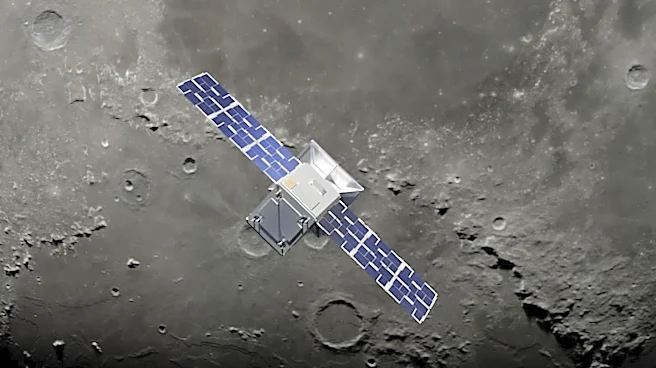
NASA engineers, in collaboration with Texas A&M University, a.i. solutions, and Purdue University, have published detailed strategies for managing spacecraft traffic around the Moon's planned Gateway spaceport. Gateway, intended for a near-rectilinear
halo orbit (NRHO) shaped by the gravity of both Earth and the Moon, will not operate like a traditional airport. The study addresses the complex problem of where spacecraft can wait if a docking port is unavailable, without wasting propellant or risking collisions. The proposed solution involves placing Gateway and loitering spacecraft on the same orbital path but separated in phase, like beads on a string. This 'relative stationkeeping' method, where the waiting craft targets Gateway's projected motion plus a time offset, proved more predictable and safer than independent flight plans. Simulations tested nominal separations of 60, 30, and 10 minutes, concluding that separations of tens of kilometers were likely unsafe for medium-term loitering.
Why It's Important?
This research is crucial for the safe and efficient operation of NASA's Gateway, a cornerstone of the Artemis program aimed at returning humans to the Moon and establishing a sustained lunar presence. Effective traffic management is essential to prevent collisions, conserve precious propellant, and ensure the timely arrival and departure of crewed and uncrewed missions. The unique gravitational environment of the NRHO presents significant challenges not encountered in Earth orbit, making these detailed simulations and proposed strategies vital for mission success. The findings will directly inform the development of flight rules and operational procedures for Gateway, impacting future lunar exploration, scientific missions, and potential commercial activities around the Moon. The safety and reliability of Gateway will be paramount for its role as a staging point for deeper space exploration.
What's Next?
The published research provides a foundational mathematical beginning for Gateway's traffic management. The next steps will involve translating these strategies into concrete flight rules and operational procedures, which will require further refinement based on vehicle-specific navigation performance, propulsion behavior, and agreed-upon safety margins. Flight controllers will need to integrate these findings with real-time data and adapt them to various mission scenarios, including emergency departures and communications outages. As Gateway modules are assembled on Earth, the development of these procedures will continue in parallel. Future research will likely address other aspects of cislunar traffic management, such as debris mitigation and managing traffic outside Gateway's immediate vicinity, as lunar activity is expected to increase with more international and commercial missions.
Beyond the Headlines
Beyond the immediate operational needs of Gateway, this research highlights the evolving complexities of space traffic management in a multi-body gravitational environment. It underscores the shift from simple orbital mechanics to sophisticated relative navigation and control, which will be critical for future deep-space missions and potential space infrastructure development. The concept of an 'invisible infrastructure' of predicted trajectories and navigation updates represents a paradigm shift in how space operations are conceived and executed. This work also has broader implications for international cooperation in space, as multiple nations and private entities plan missions to the Moon. Establishing common traffic management protocols and safety standards will become increasingly important to ensure the long-term sustainability and safety of lunar space, potentially leading to new international agreements and regulatory frameworks for cislunar space operations.