



What's Happening?
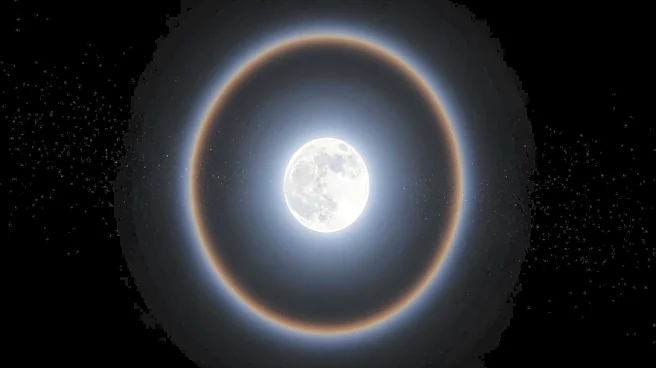
An astronaut aboard the International Space Station (ISS) captured a remarkable image of a lunar halo while orbiting above the Indian Ocean. The phenomenon, known as a lunar halo, occurs when moonlight refracts through ice crystals in cirrus clouds, creating
a ring of light around the moon. The photograph, taken by the ISS Crew Earth Observations Facility at NASA's Johnson Space Center, showcases the moon's light bending through the atmosphere, revealing the intricate interplay of light and ice crystals.
Why It's Important?
This image provides valuable insights into atmospheric optics and the conditions that create such phenomena. It highlights the role of the ISS in advancing scientific understanding of Earth's atmosphere and the natural events that occur within it. The photograph serves as a tool for education and public engagement, illustrating complex scientific concepts in a visually compelling way. It also underscores the importance of space exploration in enhancing our knowledge of Earth's environment.
Beyond the Headlines
The study of lunar halos and similar phenomena can contribute to broader research on climate and atmospheric conditions. Understanding how light interacts with ice crystals at high altitudes can inform climate models and weather prediction. The image also emphasizes the interconnectedness of Earth's systems, where atmospheric conditions can be observed and studied from space, offering a unique perspective on our planet's dynamic environment.