



What's Happening?
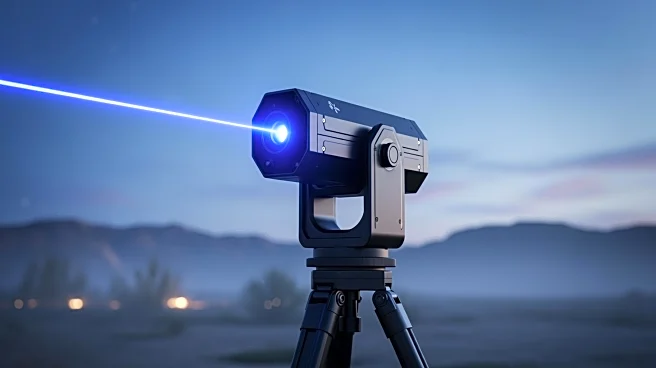
Laser weapons, long a staple of science fiction, are now being deployed by militaries in real combat scenarios. The Ukrainian military has introduced an anti-drone laser weapon called the Sunray, while the US military has used lasers to neutralize drones
along the Texas-Mexico border. This marks a significant technological advancement, as laser weapons have been under development for decades. The technology has evolved from bulky, chemical-based systems to more compact, solid-state lasers that can be mounted on vehicles.
Why It's Important?
The deployment of laser weapons represents a major shift in military technology, offering advantages such as speed, precision, and cost-effectiveness. Lasers can engage targets at the speed of light and have a theoretically unlimited magazine, as they only require a power source. This development could change the dynamics of modern warfare, providing new capabilities for defense against drones and other aerial threats. The use of lasers also raises questions about safety and collateral damage, as their beams can travel long distances and potentially affect unintended targets.
Beyond the Headlines
The introduction of laser weapons could lead to ethical and legal challenges, as their use in combat may not be fully covered by existing international laws. The potential for collateral damage and the invisibility of laser beams pose unique risks that require careful consideration. Additionally, the proliferation of laser technology could lead to an arms race, as other countries seek to develop or acquire similar capabilities.