




What's Happening?
An international research team, led by the National Astronomical Observatory of Japan (NAOJ), has discovered a complex network of magnetic structures above seemingly calm regions of the Sun. Utilizing the Sunrise-III solar observatory, which ascended
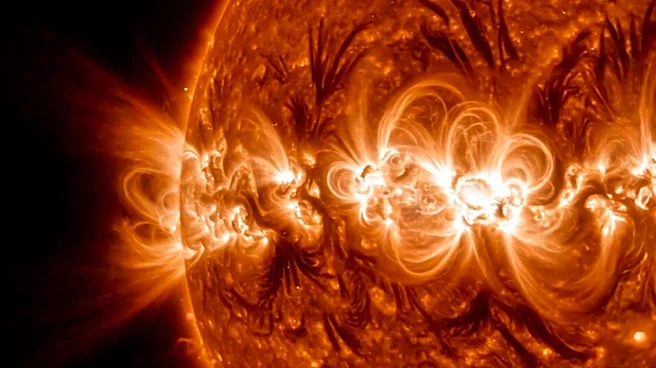
into Earth's stratosphere aboard a balloon in 2024, astronomers observed intricate, thread-like magnetic features that were previously difficult to detect. These findings reveal that even the Sun's 'quiet' areas, which cover most of its surface, contain elaborate magnetic fields extending through the chromosphere, a layer of the solar atmosphere. The magnetic canopy, formed by magnetic fields spreading outward from the solar surface, is not a smooth structure but rather composed of numerous narrow, thread-like features. Computer simulations suggest that movements on the solar surface twist these magnetic field lines, creating the observed intricate patterns.
Why It's Important?
This discovery is crucial for understanding how energy is transferred and dissipated throughout the Sun's atmosphere, particularly in regions that appear inactive. The Sun's atmosphere, including the chromosphere and corona, is significantly hotter than its surface, a phenomenon that has long puzzled scientists. The newly observed intricate magnetic web provides new clues to how energy generated by motions near the solar surface travels upward and contributes to this heating. By revealing that even quiet regions are magnetically active and complex, the findings challenge previous assumptions about the simplicity of these areas. This enhanced understanding of solar magnetic activity is vital for improving space weather predictions, which can impact Earth's technological infrastructure, including satellites, power grids, and communication systems.
What's Next?
The detailed observations from Sunrise-III will be used to refine models of solar atmospheric heating and energy transfer. Researchers will continue to analyze the data to understand the dynamics of these magnetic threads and their role in the overall solar energy budget. Future studies will likely involve further balloon-borne missions or advanced space telescopes designed to provide even higher-resolution observations of the Sun's magnetic fields. The goal is to build a comprehensive picture of how magnetic activity, even in seemingly calm regions, contributes to the heating of the Sun's atmosphere. This ongoing research will help scientists better predict solar flares and coronal mass ejections, which are driven by magnetic reconfigurations and can have significant effects on Earth.
Beyond the Headlines
The uncovering of this mysterious magnetic web highlights the complexity and dynamic nature of our star, even in its 'quiet' moments. It underscores that what appears calm from a distance can be a hive of intricate activity at a finer scale. This research has broader implications for stellar astrophysics, as understanding our Sun's magnetic processes can inform our knowledge of other stars. The use of a balloon-borne observatory like Sunrise-III also showcases innovative approaches to overcoming atmospheric interference, pushing the boundaries of observational astronomy. The findings contribute to a deeper appreciation of the fundamental forces at play in the universe, revealing the hidden mechanisms that power celestial bodies and influence their surrounding environments.